Tomato Flesh
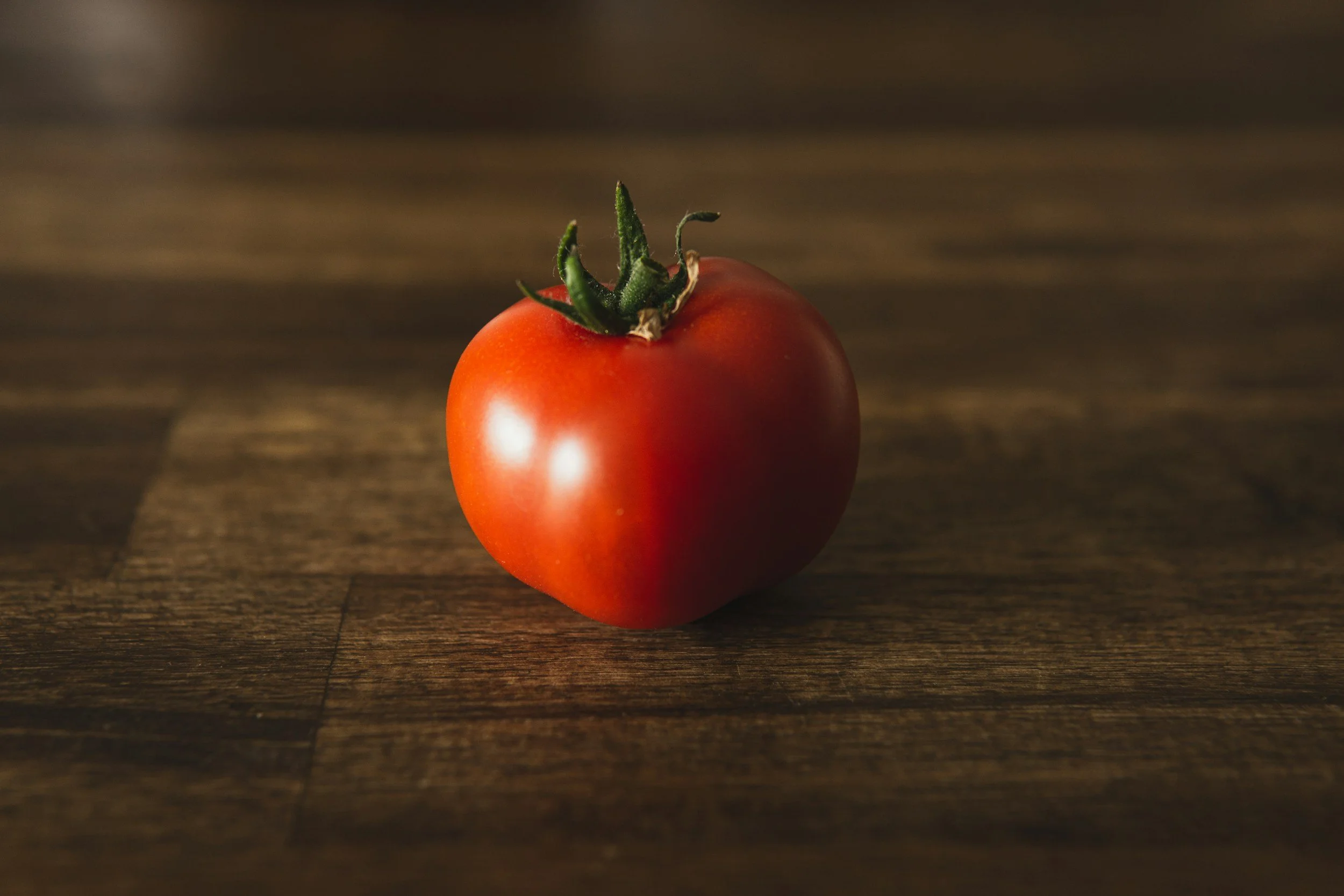
by Naomi Brown
The world, according to Delarue, could fit into two copper coins if all its particles were packed closely enough together. She had heard, indeed, that her own small intestines were over twenty feet long when stretched out. Not to mention her nerves, which ran for forty-five miles. She rubbed the pennies together between her forefinger and thumb, hovering above the fountain. It was a small, carved, stone thing affixed to the wall at the side of the house. The water it held was stagnant and olivine, though it glittered slightly. She thought she remembered her father saying once that he had bought it at a road show in Lubbock and installed it himself. If the fountain were about twenty times bigger, it might have reminded her of Italy.
A grackle crowed in the distance and the noise was swallowed in the stifling humidity. Delarue imagined the ephemeral sound of a Lone Star cowboy whistling from the bottom of a well. Snapping out of her daze, she released her grip and let the coins tumble into the water. Then the thought: Was I supposed to make the wish beforehand? Delarue had the urge to plunge her hand in and try again, but that would be like double-dipping, or grabbing something out of the trash. Instead, she plucked a couple of leaves off the frail Texas Redbud planted beside the fountain. It was a little like herself: unassuming and maybe a twinge crooked. Maybe also a bit charming. With two waxy green leaves at the ready, Delarue mouthed: I wish I didn’t remember diving lessons, and I wish I could have a genderless body with washboard abs. She spit on the leaves before seeding them in the mélange of her desire, stalking out of the yard and settling on the front porch.
There weren’t many places at home to mope about, which was the only thing Delarue enjoyed doing on her twice annual visits. Summer and winter. One long and one short. She hardly felt the difference, as the days bled together whenever she was here. Her childhood, creeping over her shoulder, smoked from dawn to dusk. It got fat off of johnnycakes, spoke out of turn, and spent hours in the bathtub. Meanwhile, her mother worked away in the kitchen. She was, at that moment, cooking black-eyed peas: a food meant to bring luck to the family in the coming year. Caroline bought these beans dry and their soaking, boiling, cooling, and combining with cilantro, fresh tomatoes, and minced jalapeño was a labor in progress.
Over a cutting board, Caroline thought to herself, I have achieved every aspect of success in my life through slow and constant, deliberate effort. Chopping to her was like—what do they call it? Mindfulness? Something of that sort. And the thing was, Caroline considered herself to be well-educated, yet never cared that she performed all of these duties her former college peers with edgy haircuts referred to as “women’s work.” In fact, she believed if she didn’t feed and look after children, she would probably have lost her mind entirely by now. Caroline had three adult babies. Now, she drove the kids in her neighborhood to their athletic games, their speech and debate competitions, their school plays their parents couldn’t attend. Caroline couldn’t help it; she had gotten into a habit. Like that village woman they filmed a documentary about who took care of over eighty children—that was how she saw herself.
Yet, her own progeny never seemed to notice her desperation. Her husband, a tiny man who never slept, still received her affection—if only in small doses. Since he was no longer very interested in her cooking (he was skinnier by the day), and infrequently saw Caroline in a sexual light, she didn’t know at times what to offer him. She had always been one to show her love through actions. Words were silly and meaningless to Caroline.
When she was a child, her father slowly fell prey to a “pills” addiction, and often came home in a despairing mood—mumbling about imaginary things, speaking gibberish, and pulling on his skin. The next morning, he would always wake up fresh and clean at 6:30, brush her and her sister’s hair, and put them in the car to school. Kisses on the top of the head. His long eyelashes would point at her through the window of the backseat as their mother pulled out of the driveway.
Caroline called out to her husband and he materialized in the kitchen as one long spinal column.
“Yes, dear?”
Leonard always called her dear. His beloved girl, Caroline, who looked to him like she hadn’t aged since forty. He tried to give her a look of domicile softness, one that would put her at ease asking him to rake leaves from the gutters or repair a cabinet door. He’d tired of whittling in the armchair and wouldn’t actually mind something to put himself to for the afternoon.
“Have you seen Della?” said Caroline, with a finger in her mouth. She was tasting the beans as they were at that stage.
“Outside, I’d think.”
Caroline made a little face, a quick twitch of her lips that made Leonard think he ought to go and get her. In this context he was usually pretty good at reading Caroline. Her gestures insinuated the words that lurked underneath. Those not to be voiced for reasons he didn’t understand.
Once, long ago, when they were dating, as a gift, Leonard bought Caroline a thesaurus. After the ensuing fight (her twitching and waving her hands, him talking in a giant circle), he came to understand that she knew exactly how to describe what she felt or what she thought, but chose to behave otherwise. Verbal communication was reserved for urgent matters.
Leonard went out back and found Delarue where he expected to: legs crossed in the red Adirondack, asleep under her sunglasses. He cautiously approached, inevitably making the boards in the porch creak despite his weightlessness. She turned her head, suddenly awake. “Hey, Dell,” he said.
She pushed the glasses off of her nose and onto her forehead, squinting her black eyes.
“Um, your mother is in there.” Leonard pointed with his thumb. “She wants ya, I think.”
“For what?” Delarue replied immediately.
Leonard clearly and obviously didn’t know the real reason, but knew he couldn’t coax her to come in without some kind of explanation. “Strong hands to open a jar, I figure.”
Delarue looked her father up and down. His knobby elbows, bow-legs, hollowed cheeks. She stood silently, opting to go in the front door instead of following him through the side. She imagined a house with two empty door frames on a cliff edge, completely surrounded by full and opaque clouds. A powerful wind came through, pushing the girl inside toward one of the openings. The girl had just awoken from sleep, and could not remember which side of the house faced the precipice.
In the kitchen, Caroline turned and smiled at her only daughter, who could’ve been a model if only she were a lot taller. Delarue who, in khaki shorts and a faded grey t-shirt, looked like she’d just washed ashore. A common Venus. Delarue searched the countertop for any semblance of a jar.
“Thanks for seeing me,” Caroline started. “I thought maybe while I prepped these things we could have a little talk, you know?” She smoothed her apron, kept smiling, and gestured to a kitchen chair that Delarue might sit in. Instead, Delarue stood, shifting her weight from right foot to left. “Lots of times when you come,” Caroline continued, “I hardly see y’all. And I know that over dinner, we all sit together and talk about the things that are going on in the world. Your brothers share with us a little about the Twin Cities, but I feel like I never really hear from you about your life.” She paused there for a moment and stirred the beans. Then she plucked a tomato from the vine and held it out behind her, over the shoulder.
This was meant for Delarue, though whether to cut or snack on she could not tell. Delarue stepped forward and grasped the fruit. Then she went and sat down at the table, feeling mildly intrigued by her mother’s sudden sentimentality. “Can I eat this?” she said.
Caroline brought over a cutting board and chef’s knife. “Dice me half and keep the rest. You can start wherever you want.”
Delarue started cutting the tomato. As much as the notion of the two of them working together in the kitchen while her father did God only knows what was bothersome to Delarue, she quieted her own impulse to walk away. Her voice felt thin and soft as it left her mouth, like small puffs of candy floss. “I wished for two things today,” she said. “I can’t tell you what because then they won’t come true.” The blade of her chef’s knife slid through the tomato flesh at wild angles that felt as perverse to her as they probably appeared to an onlooker. Delarue could only call to mind the word tunneling. “Sometimes, when I’m alone in my dorm at school,” she said, “I feel like Auntie Randy’s spirit followed me there. She takes things from my mini fridge.”
Caroline turned only her neck to look at Delarue in amused disbelief. After a short pause: “Any boys?”
Delarue flinched at the mention. She was far from having a sweetheart, but she sometimes let her neighbor from across the hallway come in if he was lonely, or she was lonely. “Want to play Bananagrams?” one of them would ask, and then they’d spread the tiles out on her bedroom floor. When they got to having sex, most of the time they stayed down there, or did it against the wall. Delarue’s college bed was perpetually covered in books and magazines. “If there were any boys, don’t you think I’d bring one back here?” she said.
That relieved Caroline a little bit. Her thin slicing of radishes became a little more light-handed. Her daughter was a good girl—just waiting for the right one to come along and show her some chivalry.
“Actually,” said Delarue, feeling suddenly emboldened, “I was thinking and I’ve seen a lot of girls getting breast reductions online recently. Living here it gets so hot, and with climate change, it will just keep on getting hotter. It’s unfortunate, but I think a lot of girls my age are sacrificing their sex appeal for a level of comfort they never thought they could achieve in decades prior. Say what you want about plastic surgery, but I think it’s a really good investment in a future of equal opportunity.”
Caroline didn’t know what to make of any of that, so she kept cooking and changed the subject. “Have you spoken to Maddy since he went back to St. Paul?”
Delarue crinkled her nose. She had, in fact, texted her brother a couple of times: when his plane landed, when she was bored and sent him 8Ball Pool. Spoken was a strong word for their exchanges. Delarue did actually enjoy talking to Madison, but since they lived what she felt were dramatically different lives, there wasn’t always an easy way to broach conversations. When they drank together at the holidays, they always had fun. “We text,” Delarue said.
Caroline nodded and kissed her teeth. How her twin sons ended up in the Twin Cities was still a mystery to her. After college, they each came home for a couple of months to job search, and then subsequently—one after the other—moved to Minneapolis and St. Paul. It was paradise in the summer, they’d told her. Not so much in the winter time. Madison, who liked his parents a little better than Jacobi did, took all his PTO in December, spending three weeks with them before going off for the next year. It was New Year’s Day, and he had recently left the nest for a job as a bank representative. “I wonder if Maddy will marry Tina,” thought Caroline out loud. Her surfaced words were met with an exaggerated gulf of silence.
“Yeah,” said Delarue, before sticking a tomato wedge in her mouth. She liked Tina in much the same way that she liked tomatoes. Good in small doses, best in the summertime, and very pleasing as a condiment on a burger. Was life the burger? Her thoughts drifted away as Caroline began listing her own favorite qualities of Tina’s.
“Eesh, but I didn’t mean to get off track,” Caroline said. “You should keep telling me things. I like to hear what you think. For example, what are your political views? Are they different from mine and your father’s?” Caroline stopped and waited for Delarue to say something. She could say anything and it most likely wouldn’t upset Caroline. Caroline wasn’t easily affected by words.
Delarue was certain that her political views were different than her mother’s—though, for her father, she couldn’t say. “I’m a libertarian,” she proclaimed. She didn’t know if that was true in the holistic sense of the truth, but it was definitely true in the sense that she was strongly against authoritarianism. “I think we should abolish prisons and let people build whatever they want on their own land. I think…um…I think every person should understand how to live off of the land.” Now, Delarue was treading into the realm of bullshit, and she knew it. “Well, Mom, I know you read my ballot before it was mailed in. It’s fine, by the way.” Delarue ate more of the tomato. She scanned the room in search of things to pontificate on for Caroline’s satisfaction.
Caroline felt like she might cry. The tears burned at the sides of her vision, and she did her very best wide-eyed stare into the sink basin to try and avoid their falling. Something about the way this conversation felt—like an improvisational skit between two strangers. Caroline wasn’t sure how well she knew her daughter anymore, and she wished their conversations were easier. Even though she didn’t have to prep any onion, she began cutting one. She listened as Delarue described the various coffee mugs she had grown up drinking from, and her level of affection for or animosity toward each one.
Outside, Leonard was splitting wood. It was a very impractical chore to be doing at that moment, as the winter that year had thus far only dipped down to fifty-five degrees. They didn’t build fires to keep warm. Occasionally, Leonard and Caroline cooked over a flame just to do something different. With every throw of his axe, Leonard’s wiry frame underwent a mechanical contortion. His shoulder blades poked out the back of his shirt as he drew it up. His joints and sinews rolled in the process of bringing it down. His end position was a hunch, which he knew was poor posture, but really the whole of the act was less than ideal. Despite the disappointment he felt with himself, Leonard could not figure out how else to apply what little energy he possessed. He certainly wasn’t able to go into the kitchen with his wife and daughter. Whatever he could clean or tidy around the house would simply get re-done by Caroline later that day. She didn’t like how he cleaned. She tried to be sensitive and fix things when he wasn’t around, but Leonard knew.
At that moment he sensed a burst of hunger: a rarity for him nowadays. He reached into his pocket for a protein bar. That was what the doctor suggested he eat if he ever got hungry between meals. The bar was wrapped in Day-Glo packaging that somehow enhanced its chemical nature. Leonard stopped to imagine what his own father would have made of such modern food products if he were still around to see them. If my wife is a beautiful tomato, he thought, I’m certainly this ultra-processed bar. She’ll ripen and grow until the day she turns. Meanwhile, I’m shelf-stable. He unwrapped and bit down. Not a bad thing.
In the yard, the grackles stirred, hopping around in ways they hadn’t done just moments prior. The trees rustled and the sky darkened. Aside from the cries of those histrionic birds, there was a general quiet over the earth. A drop hung from the lonely fountain. Why, indeed, was it lonely when a tree stood beside it? Caroline and Delarue muttered to themselves, shutting the windows. Outside, Leonard felt a drop of rain land on his head and turned his murky face towards the expanse of grey. Then, organ-like sounds came from all directions, permeating every other clumsily spoken word and half-baked thought. The retired neighbors adjusted their hearing aids. They looked at each other and mined down their own neural pathways, suddenly remembering. Then the question: How long had it been since the last emergence?
A sea of voices from every direction swept in crescendos and abated only to lower sounds that were less cry and more rattle. Serpentine, menacing, and poised to attack. If you tried to pick out a note or describe the timbre, you could not do it. Instead, a shiver not unlike brain freeze would work its way through you. Leonard saw them, their animated bodies moving at the edges of his vision. A few arose from the tree branches like bits of smoke. They were dark and winged and a little alien up close. He remembered them and went inside.
Caroline shook her head in distaste. “I thought this was a summer thing,” she said. “Not something to happen on New Year’s Day.”
Delarue was only five years old the last time she saw them en masse. She couldn’t help but to grin. One of the bugs crashed against the kitchen window, sputtering about and whirring from a voice box deep within. Delarue observed its exoskeletal anatomy and saw a creature exquisitely free from the tyranny of appearances. It was exactly the same as every other stain out there, all tumbling into each other. What did they do, after all, except for air out their new wings and reproduce? It was simple, apocalyptic, and marvelous.
Caroline was quite bothered by the cicadas. They presented an unexpected obstacle to her carefully planned family dinner. Despite the hours she had put toward her pot of black-eyed peas, she resolved that they would try to out-drive the emergence. Caroline wrung her hands and picked the car keys out of the bowl on the entryway table, shook them at her disciples, and they, knowing her modes of revelation, followed out the door and into the brutal afternoon.
The graphite blue Chevy Murano rolled over creeping insects on the way out of town. Somehow, they all knew who would drive (Delarue), and where they were headed (the strip mall off of Exit 312 with its bounty of dining options for middle-class Americans). Pulling into the car lot, Delarue was met with a mixture of nostalgia and strife. The Sweet Tomatoes of her childhood—those ochre trays, black olives, and red Jell-o—had been replaced by a Cava here and a Sweetgreen there. She took her hands off of the wheel. “Let’s go to Chili’s,” she said matter-of-factly.
Though the thought of cheese and beef inter-mingling on a dinner plate was almost enough to make Leonard sick in that moment, he and Caroline obliged. Red leather booths and tortilla chips resting in a plastic wicker basket sounded right. Caroline would find a way to take some chips home when the three of them eventually went. She would dip them in her beans.
They were seated by a teenaged waiter with forearms covered in gummy plastic bracelets, the kind they pass out for breast cancer awareness or in memory of a person who passed away too young. The kid handed them menus and brought them tall glasses of ice water. Something by Owl City played softly in the quarter-filled dining room. Delarue sat facing her parents, becoming aware of their hands clasped together beneath the table. The more she thought about the past two weeks, so much of it spent alone in her childhood bedroom or on the porch stoop, it made her want to peel the booth of its plastic upholstery. The angel of Maddy and devil of Jacobi sat on Delarue’s shoulders. One comforted her out of sympathy, while the other just gazed across the table. Her brothers extended their hands to her. Inside each of them was a penny, dripping wet. Their images were soon destroyed by the arrival of three frozen margaritas, sweating the perfect amount.
“Cheers,” Caroline said, breaking the silence. “To my beautiful family.”
She gripped Leonard’s hand a little harder, and he examined her more closely, trying to intuit her the way he once could. His formidable wife, who bloomed in the summer and became a nightshade in winter, protector and provider. Her honey-brown eyes betrayed currents of intensity under their surface.
“Cheers,” Delarue replied, raising her salt rim. “Happy New Year.”
Behind her parents, in the back corner of the restaurant, a flat-screen TV played a cable channel that had switched and started showing a documentary on clinical surgical trials. A young girl was shown giving an interview about her battle with cancer, inter-spliced with footage of laparoscopic tubing that wormed through flesh, cutting here and there at the tissue in its path. At times, the shot widened to show the whole operating room, consisting of two surgeons and three nurses. The surgeons bent over the child’s frozen body, which was mostly covered by a sheet, save for the clipped-open abdomen. One nurse placed blood-soaked surgical tools into a metal basin, while another readied instruments with alcohol.
Delarue found herself paying close attention to the program, which cut back and forth between inner and outer worlds. A shot of the girl holding a teddy bear and speaking calmly was followed by the girl’s innards. The girl wiping a tear from her face, and her mother stepping in from off-camera to give her a hug. Then, a close-up of the head surgeon’s eyes, steadily fixed on the operation over a powder blue mask. The girl smiling and pointing to a long white line on her stomach, giving her mother a high five. Suturing with staples, suturing with needle and thread. There was no sound and no subtitles. The words were meaningless, anyway.
About the Author
Naomi Brown is a writer from San Jose, California, currently working toward a Bachelor’s of Media Studies at the University of British Columbia in Vancouver. Living abroad in Canada (and further, on a university exchange to Copenhagen, Denmark) has inspired her to deal with American themes in her creative work, reflecting on what it means to inherit a nationality defined by individuality, plurality, and tension. With themes of identity, faith, and environment as common chords across her poetry and short fiction, Naomi is most interested in exploring how characters navigate “middle ways” of being in an increasingly uncertain contemporary world.