Distribution
by Michael Thériault
On her first bus ride in her new city, San Francisco, Theresa saw something that gave her the idea. She had walked from her motel room, just past the southern boundary of the city, a half-hour to catch the 14-Mission and start looking for work. Sitting in the centermost seat at the back of the bus, she watched a large heavyset ruddy woman sitting in front of her open first the sliding window atop the larger, fixed pane behind her, then the purse on her lap. The window’s opening was small, but the purse’s seemed wider than the jaws of the bigger gag groupers she’d seen brought ashore from sportfishing boats near Jacksonville.
Jacksonville was the city she had tried to make her home.
The purse was capacious, of heavy cloth in antique blooms and leaves as though cut from some great-grandmother’s couch. From its maw, the woman pulled a piece of paper, then she reached again behind and above her and held it out the opening. It fluttered a moment and then, released from her surprisingly slender fingers, shot back past the moving bus’s windows and beyond sight. Theresa hadn’t identified the paper. Spent wrapper? Tissue? Napkin? Something else?
“Something else” suggested the possibility.
In her motel room, one suitcase contained letters bundled in cotton twine. She brought them west on the interstate buses even though they were a burden. Their physicality, and maybe their association with tradition, seemed to demand some special, even ritual, disposal, not a trash can, not simply being left behind. Burning them on a beach seemed a possibility, but between work and packing she hadn’t made time.
She abandoned three blouses from one of her two suitcases to make room for them.
Theresa’s move the year before from Orlando to Jacksonville had made her the first of seven siblings to leave home. She changed her cell phone number and email address with the move, but it seemed wise for the sake of official notices, unpaid bills, and to avoid confusion with her mother, to provide a mailing address to at least one person she felt could be trusted not to share it. Her sister Annette understood her best. She wouldn’t mind seeing Annette again. Annette, then.
It pained Theresa to imagine how their mother might have extracted the address from Annette, though she was sure it was by nothing physical. The pressures of love were horrible. It pained her also to imagine Annette’s guilt when their mother shared the address with Theresa’s friends, so that they, too, could apply these pressures. Theresa asked herself why she should read the letters. Her answer had been exactly this: They had come from love. They forced the conclusion that Jacksonville was too close to Orlando. Her address known, the ease of visits would tempt friends and family.
San Francisco was not close, and it was also a city that frightened them. By what they had heard on their televisions and radios and even from their pulpits, San Francisco was a Sodom half-zombified by drugs, half-buried in shit and trash and the tents of the homeless. But she had glimpsed behind a Jacksonville coffee shop counter a postcard celebrating a day at San Francisco’s Baker Beach, and it told her she could find some way to live amidst the reported apocalyptic decline, perhaps even pleasantly. If her friends and family ever did learn of her whereabouts, they might hesitate to seek her, might even write her off for lost. This suited her.
The crawling intermittent Wi-Fi of the motel gave her a list of employment opportunities in the apocalypse. She had previously worked as a receptionist for an optometrist in Jacksonville. Here two dentists and three doctors, one an ophthalmologist, needed receptionists for the zombie hordes. Thus she rode the 14-Mission with a résumé to print out, photocopy, and deliver; thus she saw the paper take flight.
When next she rode the 14, toward two interviews resulting from the résumé, she carried the bundles of letters. She sat in the seat directly across from the one in which the woman with the fishmaw purse had sat. Above her head was a matching window. She reached up and opened it. She unknotted one bundle’s cotton twine. From a pink envelope she freed a pink sheet and read:
girl we all miss u here roxanne says how she gonna have a wedding without u and i should tell u u best get in touch
Hand up again, she held the liberated letter out the open window. A wind maybe from the city’s streets or maybe from the bus’s passage through their foggy morning made the pink sheet flutter between her fingers. The flutter sent a small charge down her arm.
She released the letter and did not turn to see the paper’s flight.
She kept the envelope. It provided more information than a first name by which she might be found. There was no point in taking the chance someone would decide to try, and an envelope followed no tradition demanding ritual disposal. She could trash it in ways less dangerous.
The next letter was on a squat rectangle of thick buff paper, from an envelope of the same material lined with a thinner, gold-bordered paper in brown. The sheet’s watermark told her it had not come cheaply.
We’d just started to hang out, and I had no idea you were planning to leave. I wondered a little if this might be because of me, but the thought seemed egotistical, in any sense in which I considered it. I hope you’re well. You left so suddenly I hadn’t brought myself to tell you how beautiful you are, and how smart.
His name was Andrew. She released the letter out the window without giving it the opportunity to flutter.
Several blocks later all that remained of the first bundle, from friends and acquaintances, was the loose stack of empty envelopes. Gutted, they collapsed when she tried to reconstitute the bundle with the twine. She rolled them instead into a little tube. Their sprung resistance against the knotted stricture of the twine made them a functional package and restored her control over them.
All but one letter in the second bundle was from her mother.
I ask myself what I did wrong. I can think of so many things. Please forgive me. Know that I love you. We all do.
The tomatoes are beautiful this year. I know you enjoyed them. I was slicing them last night and had to stop and cry.
Everyone asks about you. I tell them you’re figuring things out. I pray every day that you do.
God gave you so many gifts. Your skill with words, your imaginative problem-solving, your facility with math. Your father and I, and any of your teachers I know, we all thought you would go on to college, and thrive, and do wonderful things. You still can. If ever…
She let the last letter but one from the bundle flutter longest in the air outside of the window, in the space she was departing. She reveled in the flutter’s electricity, and when she opened her fingers and ended it, the succeeding sensation was of a lightness as corporeal as emotional, and of a joy with no content but itself.
The bundle’s remaining letter, the one not her mother’s, was from her father.
I hesitated to write to you but I think I must. Your mother has asked me to besides. I know I have not been as engaged with your life as has she. I have felt myself a complete idiot where my daughters are concerned, and their emotional growth and needs. I devoted myself instead to making sure you lacked nothing. I am grateful to your mother every day for her patience with my clumsiness and incomprehension. I can’t ask the same patience from you. A father’s child grows up, a father’s child grows away, it seems to me natural. I mistrust words. I have trusted clothes and food and a nice home, and schools and summer camps and vacations, to speak for me. I can’t know they have. So here are words. Know that I love you. Know that your mother and I want the best for…
She was growing heavy again, and new gravity resisted her hand’s path to the window.
She overcame it. The letter followed the unseen flight of others.
All of the last bundle was from Annette.
…in this box maybe not the last of your things you forgot but I’ll keep looking and send along what I find. Also here’s a couple bonus things from a yard sale I think you’ll…
…goes around the house mewing before bedtime like she’s looking for someone I guess you know who…
…get it. It gets to be too much, all the, Why don’t you try this, the, Don’t you think it might be better if you, the, You are so gifted and we only want…
…threw my mug against the wall beside the sink almost through the window and she stared at me like, How can saying we love…
…me along. I’ll get some money together. I’ll do any work. I know no high school diploma is a problem maybe but maybe I fix that later. Wherever you’re going, don’t without…
The last of the bundle left her fingers just as her bus passed another, an intercity bus disembarking passengers across a plaza from a long building whose wall of bulbous white undulations was perforated in some distribution her quick glance couldn’t decipher into pattern. The distribution’s refusal of analysis suited what was in her just then, she felt. She had distributed her former self across the city, where she might be found in bits but not known, but where the love offered her might be felt by others. She asked herself: How could a moment be at once so thrilling and painful?
********************
“It’s been three weeks,” Theresa said to Malika, the dental hygienist at her new job. They were in the elevator on the way down to lunch. “I think I’m figuring out the Northern California insurance.”
Malika was tall and slender, with skin the color of dark honey, gray eyes, and high cheekbones. Theresa appreciated how Malika’s beauty drew attention away from her own straight brown bob, rounder face, and uneven paleness. Malika was from Texas, and Theresa asked her once why she came to San Francisco.
“I’d had enough,” Malika replied.
Theresa hadn’t asked for more; Malika hadn’t reciprocated the question. Theresa was grateful for not having to articulate an answer, though if she had, she might have said it was that she wanted to distance herself from any expectation of accomplishment. That wouldn’t have said enough.
Theresa had a room near Golden Gate Park in a building well over a century old, in a third-floor flat she shared with three young women, all graduate students. When they interviewed each other, Theresa gave them the assurance they requested: she was quiet. She found no apartment in sight of her new wages, but the students proved as quiet as they’d wanted her to be, and they rarely used the kitchen, and she had the park as grand back yard. The arrangement would serve at least until a new semester and a possible turn of flatmates. Meanwhile, Theresa appreciated the seriousness of the present three and their constant example of what she did not want.
She wanted just to be, to take what the day gave.
She stood in the crowded bus on her morning commute and watched the other passengers look not at each other, but at their phones. She found nothing sad in this, but instead a species of joy: Despite any ambition any of these others might have, in this city that ambition crowded, here they were, tight in this space with her.
Theresa and Malika soon stood in a line to buy their salads, which they intended to carry in their clamshell containers to join other workers eating in Union Square.
She caught a conversation behind them.
“I picked it up from the sidewalk,” a man said, “and it was a page from a letter. The first page with ‘Dear whoever’ was missing, but the page in my hand was begging for someone to come home. You have so many gifts, you could do so much, and so on.”
At first, Theresa thought this must be one of the pages the wind took from her fingers out the window of the 14-Mission. Then she thought it might not. Maybe in this city, at once old and new, someone else had given their past to the wind, too.
Maybe many others had. This possibility thrilled her, that she was in a great company, a distribution here of the simple and plain, who walked from their doors into a morning that was just a morning.
“I was bummed by it all day,” the man said.
She turned to him. He seemed just a few years older than her and was a little taller, with a close-trimmed beard and dark, mobile eyebrows above brown eyes. She thought that under different circumstances she might have found him attractive, but his puzzled expression at her turn told her there was more irony than allure in her smile.
“You shouldn’t have been,” she said.
She turned forward and rejoiced in the line’s little crowd seeking only lunch, in the sidewalk’s greater crowd passing it with little notice.
About the Author
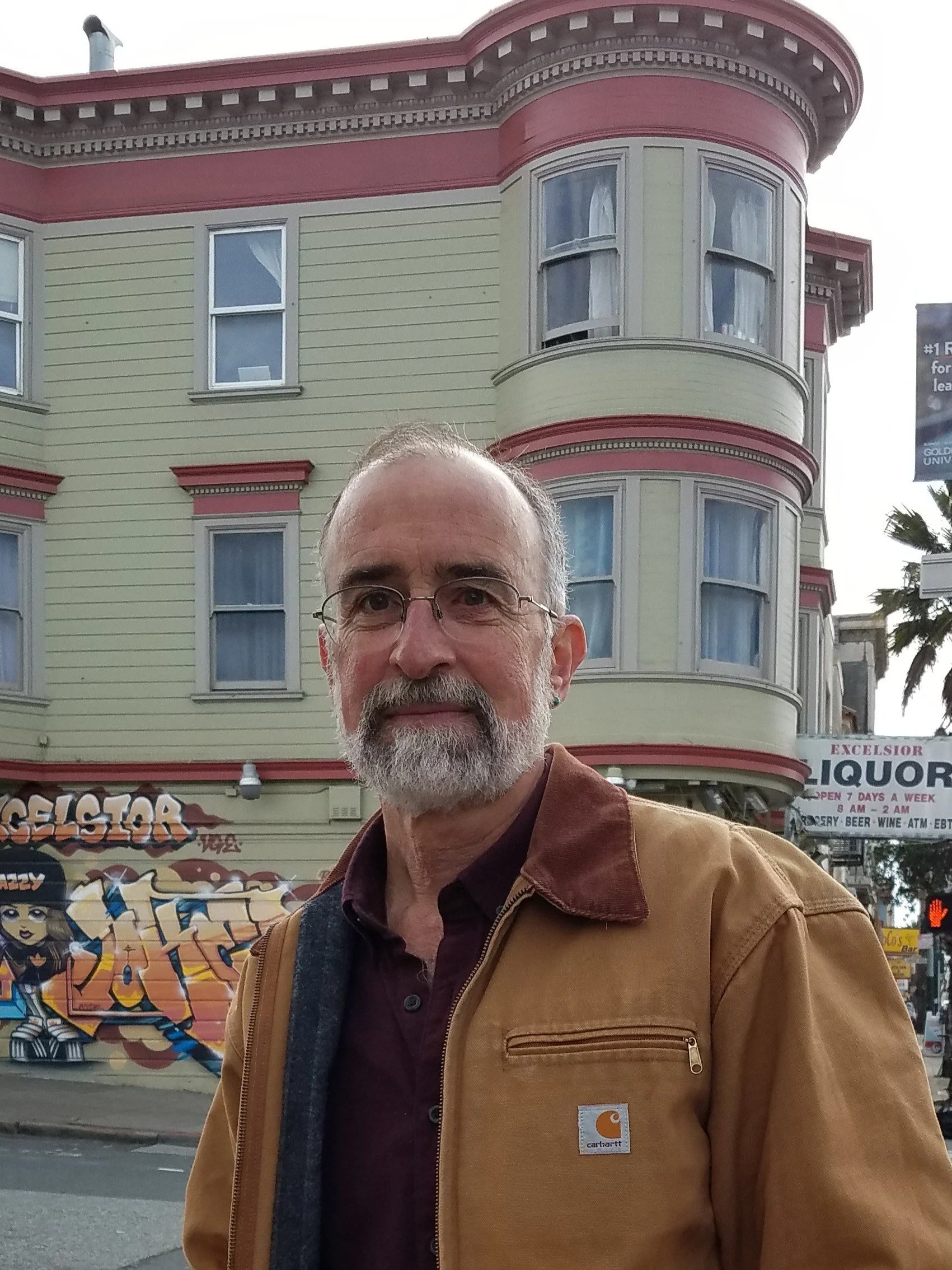
Michael Thériault has been an Ironworker, union organizer, and union representative at various levels. He published fiction in his twenties, but abandoned it for decades to support first a family, then a movement. Since his return in 2022, his stories have been accepted by more than two dozen publications, including Pacifica Literary Review, Sky Island Journal, and New World Writing. His story “An Invitation to the Gulls” was shortlisted for the Leopold Bloom Prize for Innovative Narration. He’s a graduate of St. John’s College, Santa Fe; and San Francisco native and resident. You can find him on Bluesky – @mtheriaultsf.bsky.social, Mastodon – @mtheriaultsf@mas.to, and Instagram – @mtheriaultsf.