The Diner on Bloomingdale
Dr. Ginearosa Carbone
I walked out of my fourth hotel of the night, sweat mixing with raindrops on my brow. The door closed behind me with a small click, barely audible above the roaring gutters beneath my feet. When I decided to come on this business trip, I agreed to stay at my old college friend Laura’s house. It would’ve been mutually beneficial. I wouldn’t have to pay for a hotel, and her plants wouldn’t have to die an October death. This was, in some way, vital to me with the sixty-dollar sum in my bank account until next Friday. It was obvious she was doing me a favor, but the plant situation made me feel a little less cheap. It was great that there were people in the world who gave a shit about plants.
I landed at twelve thirty in the morning, ordered an Uber to Laura’s address at 1510 West Bloomingdale Avenue, and was grateful that one came almost immediately. The autumn rain had begun to condense onto the airport windows and showed no signs of stopping. After five hours flying in cramped economy, the thrill of stretching out on a bed made my blood feel louder.
The notification rang on my phone and I stepped out into the drizzle with my luggage. The music from inside of the car’s radio echoed with static. I would’ve been able to name the song playing in the background if I hadn’t been bone tired from the twelve-hour trip. The staccato beats tried to bleed around the white noise’s edges.
Bum-bum, brrm, zzzrt. Bum-bum, brrm, ffzzt.
The driver dutifully followed the GPS’s even-toned voice toward the destination. After twenty minutes the car slowed to the middle of a dark street. “You have arrived,” the mechanical voice declared.
But we hadn’t. I saw nothing but a patch of black, wet road between two half-dead street lights, with no apartment in sight. I craned my head around and looked behind us to find much of the same. “There’s nothing here?” I asked hoarsely.
He looked at me from the rear view mirror. “I dunno, this is where it goes,” he replied, not unkind. He pointed at his cellphone as if the woman who lived inside his GPS was the final word on the situation. She didn’t respond any further.
I pulled out my own cell and checked the address on my phone. It was very possible that, fatigued, I mistakenly typed the wrong number when ordering the Uber. I was neurotic but not infallible. However, the text from Laura still said 1510 West Bloomingdale—the same as what I entered for the ride. I typed it into my own GPS which also showed I was in the correct spot. But that couldn’t be right because this patch of barren road wasn’t an apartment. I called Laura and crossed my arms, acutely aware of the driver’s growing impatience. No answer. I called again, but still no answer. It was nearly 1:15 in the morning, and I presumed she was sound asleep in another state.
“Have you been here before?” the driver asked.
To my friend’s house? No. To Chicago? Also no. Raindrops pattered the roof of the car insulating the momentary silence. “No,” I finally replied.
The driver rounded the block several times as a show of good faith, but the only houses in the nearby vicinity were cracked and battered. Nothing like the high vaulted ceilings of Laura’s posh apartment I saw in the videos she’d sent. The car slowed and the driver asked me, finally, “Whadya want me to do?”
I could tell he wanted to help me, but he also wanted to make his nightly wage picking up other riders. The sound of all the potential new clients pinged! its Uber notification noise from his dash.
Kindness fades like worn-out leather. My dad used to say that. “Can you just drop me off at the Hilton down the street?” I said.
He nodded and his shoulders relaxed, a physical sigh of relief at the shift of responsibility.
I wracked my brain on how this could’ve happened. A typo most likely. Laura had to have accidentally entered a wrong digit when sending me the place. She was busy. A slip of the thumb was not impossible, but it was too dark and wet out to trial the hundreds of different combinations into which 1510 could be spliced up. The best thing to do was sleep on it and figure things out in the morning.
We slowed at the stop light. Raindrops distorted the window pane, and the red light painted it like a church’s stained glass. Outside, dozens of less than sober people tumbled in every direction like living dirt clods. I felt bad as my driver watched all the potential customers slip by.
He pulled over to the Hilton.
“Thanks.”
He held his hand up in acknowledgement and drove off, his face both annoyed and happy to be rid of me.
I heaved my bag over my shoulder and headed towards the well-lit glass doors. Inside, my boots squeaked on the tile and, even at nearly two in the morning, I felt guilty for not wiping my shoes off on the mat. A large African American man in a pressed suit stood behind the desk. His smile was serene.
“Hi, I need a room for the night.”
After a few keystrokes, he said, “Oh. Unfortunately we’re all booked up.” It hadn’t even crossed my mind that the hotel wouldn’t have any rooms. The look of shock must have shifted my features, because the man went on: “There’s a lot of conferences in town for the weekend.”
He tried a warm smile. My cheeks were still numb from the rain. I didn’t try to return it. “Okay. That’s okay, thank you for checking.”
I watched as his eyes roved over the strands of wet hair that clung to my face. His own face contorted to a familiar emotion: pity. I felt my hopes rise.
“Miss? There’s a few more hotels down the street. They might have a cancellation?”
Not enough pity to reveal a secret spare room though. I nodded and then I went back into the rain.
Which brings me to now, four hotel visits and six hotel phone calls later. Despite interacting with oscillating levels of customer service, I was still on the streets. I’d been repeatedly informed of the several conventions and conceded that there was most likely no hotel space for me in the whole of Chicago. I checked my phone again. Still no call back from Laura. Disappointing but expected. Even more distressing was my phone’s battery, which had turned yellow. The corner of the screen informed me of its 36% battery life.
I walked to a bus stop and dropped on the bench next to an old man. The overhang protected our heads from the downpour. I looked over to find that, between his hands, he held what was once a newspaper, though now it was simply a soggy poultice. The pulp leaked between his fingers, though his gaze remained trained on the running words. I looked away and allowed my head to hang for a minute. My neck ached from the flight and my over stuffed duffle bag. Yellow neon lights reflected in a dirty puddle like molten sunlight, almost emitting a tangible warmth. I lifted my head and looked down the street for the light’s source. Only twenty paces ahead stood a building, on which hung a sign that read 24-HOUR DINER. The four flickered rhythmically as if it couldn’t quite make up its mind. I left the man reading the paper alone in the three o’clock darkness.
Inside the diner was too bright. I thought the neon lights on the outside were what illuminated it through the streets, but I realized now it was coming from the windows which fought to contain the blinding fluorescents inside. My shoulder throbbed from carrying my duffle bag, but at least it was warm and dry inside. In the corner to my right, a couple chatted quietly, and to my left, and old woman sat alone in a booth. A brunette waitress came out from the kitchen. “Welcome in, late night or early morning?” she said.
The clock in the corner read 3:10am. “Late night,” I croaked.
“Well follow me, little night owl, and let’s get you something to eat.”
She led me to a booth where I threw my bag, feeling the seed of hate growing for the dead weight. The room smelled like maple syrup and bleach. On the table lay a napkin with scrawl written on it. Three lines of writing in neat, blue penmanship. I craned my head over to read it, but the waitress snatched it up and stuffed it in her front pocket while. With her other hand she poured coffee into a white mug.
“Oh—” I stammered.
“You look like a girl that’s trying to perk up. Cream and sugar’s on the right there.” She pointed towards the corner of the table with her coffee pot like an extra appendage.
My plan was to sit in the diner for the next four hours until the local hotels or Laura answered their phone. Whichever came first. And to do that, I needed caffeine. “Thank you,” I replied and grabbed the mug. The warmth wrapped around my palms and up to my wrists, and goosebumps sprouted down my back. I took a sip. It tasted thin like water.
“Here for business or pleasure?”
It was obvious I wasn’t from here with my rain-soaked duffle and the purple bags under my eyes. “Business.” I have received no pleasure tonight. In fact, in that moment, I’m pretty sure I fucking hated Chicago. I forced a smile. “When do you guys close?”
“We don’t.”
My phone buzzed and I lurched for it, the caffeine having given me a new, jittery life. Laura’s name flashed onto the screen. My eyes widened.
L: I’m home. Door’s open.
My heart squeezed in my chest, like when you tip back in a chair a little too far. The message made no sense. Laura wasn’t home. She posted photos of the engagement party in Minnesota ten hours before. I went to social media, clicked on her name, and found photos of a cake and balloons and a large lake in the background. I studied the photo’s time stamp.
Another message popped to the top of the screen, blocking the photos.
L: Just come up. You always forget how to get here.
But I’d never been here before.
I tapped the small phone icon in the corner of the message, held the cell up to my ear, and listened to the screeching ring back tone. I noticed the waitress’s hips at eye-level with me. She stood by, unmoving, with her pot of coffee.
Startled, I followed the curve of her dress to her face, and found she wasn’t smiling anymore. “You don’t have to go back there,” she said under her breath while she poured more coffee into my mug. I hadn’t realized I’d finished the last cup.
“What was that?” I asked her.
I squinted up at the waitress and held my hand over the receiver of the phone. The damned fluorescents were blinding. It reminded me of getting cavities filled in a dentist’s chair as a kid. My teeth hummed with the cold.
The ring back tone continued to howl in my ear. I must have heard the waitress wrong. Her voice must have been distorted with the electric noise running through my head. A wave of fatigue washed over me.
She turned to go back to the kitchen and didn’t repeat herself. “It never ends right when you do,” she said softly with her back turned to me.
“Wait what—”
“Hi!” Laura’s voicemail chirped. “I can’t come to the phone—”
I hung up and looked for the waitress, but she was gone. The old woman held a fork full of runny eggs up to her face, but never took a bite. She paused there, hand raised, almost suspended in time. After five minutes, she placed the fork back onto her plate. The couple in the corned stopped talking and held each other’s hands reverently. I scanned the walls, but no outlets revealed themselves where I could fortify my phone’s battery. As I rotated my body in the booth, I glanced out the window to the street. Where had all the drunk people gone? All that was left were puddles and trash. My phone read 3:10am. The bars must be closed by now.
Wait. 3:10? Wasn’t it 3:10 when I got here? Two cups of coffee ago?
My phone chimed.
Your Uber has arrived.
I didn’t order an Uber? I clicked on the message. Once again, it had 1510 West Bloomingdale Avenue set as the destination. I held my breath and clicked the cancel button. A warning message flashed back at me.
Cancelling now will incur a fee.
You are being charged a cancellation fee of $23.54 because the driver is on the way.
Shit. Shit. Shit. Twenty-three bucks? I pictured my bank account shrinking until it popped out of existence. If I find Laura’s apartment, I’ll save hundreds of dollars in hotel fees. If I cancel the Uber, I’ll lose twenty-three bucks and still be stuck here.
I clicked the back button, reversing the ride cancellation, then stood and tried to find the waitress, but she was still in the kitchen. Or somewhere else that I couldn’t see. I needed to pay and leave.
Your Uber driver is leaving in five minutes.
“Hello?” I called out to no one in particular.
No one turned to answer. Not the old woman or the couple.
I dug into my pocket and dropped five dollars onto the table. Two mugs of coffee in the Midwest couldn’t cost more than that. I threw my bag over my shoulder, dashed back out into the rain, jumped into the Uber, and closed the door behind me. From the car, I saw the waitress’s shape standing at the table, rippling through the downpour. She stared at me, holding my former cash in her hand. She didn’t look angry, so it must have been enough, but she didn’t look exactly pleased either.
The car drove off and she became just another Chicago smudge on the rain soaked window.
********************
While in the Uber, I followed my own GPS dutifully. I watched with a sinking feeling in my stomach as the driver took me back almost identically the way I’d come. All this at the detriment of my dwindling phone battery. The houses thinned as we approached the same dark street, but as we pulled up near the busted street lights, an apartment now stood at the end of the street. Where brick and graffiti once stood, a towering apartment complex now rose above me. It was as if the city rearranged itself to birth it. To accommodate me.
The car slowed to a stop and the driver shifted into park. I opened the car door, dragging my bag behind me, into the rain, which had intensified on the way over, almost pushing me towards the apartment door. I stood at the complex entrance’s threshold and turned back towards the driver, squinting to see his face and blinking the rain from my eyelashes. He stared at me through the window. His face ran with the droplets of rain distorting his features. Eventually he tore his gaze from me and the apartment and hitched the car down the street.
I reached for the door knob and pushed my way inside. “Laura?” I whispered.
No one answered. I found myself in a stony hallway. The walls were cold concrete, breaking open to reveal several dark doors; the floor was bare from any personalized touches; and there were no mats for guests to wipe their feet and no vases in which to hide spare keys. I counted the numbers until I found Laura’s door, the second to last in the hallway. The only apartment with two beat up sneakers in front. I kicked one over and listened to the rattling cling! as her key fell out, exactly where she said it would be.
Inside the lights were off. It felt like walking back out into the night. Rain clouds crowded the windows, blotting out any moonlight. The air smelled of wet concrete and metal and the steady sound of dripping encased the space. I felt for the light switch with the back of my hand, and when I found it, my stomach flipped. Water coalesced on the ceiling, hanging heavily before falling onto the tile. The kitchen chairs lay on the ground at odd angles. “Laura!” I called out. Water filled my shoes with each step. Then I saw it: a Polaroid taped to the fridge, moisture curling the edges.
It was a picture of me, half crouched, one arm bracing a doorframe as if trying to pull my/herself toward escape. The other hand hovered over a puddle on the floor. My/her hair was soaked and plastered on my/her forehead. An expression, raw and desperate, seated in my/her wide-eyes, pleading. Like a fox caught in a snare.
I ran into the bedroom, still desperate to find Laura, but pulled up short at the sight of two wet and pale feet on the ground. My breath caught in my throat, and my body felt like a rotted log. On the floor laid me—or, my past self sprawled across the hardwood. Her chest rose unevenly. Smudged mascara rimmed her eyes as she stared back at me, not for help, but with the horror of realization. With the horror of failure. Her rough breaths wracked her as she lay there, pushing water droplets off her lips in ragged spouts. The water rose slowly around her, filling her ears and framing her face. Reflections of my past efforts shimmered in the puddles along the floor. I caught glimpses of struggle, anguish, and exhaustion—all unsuccessful. All failures.
The apartment hummed, water dripping louder, echoing in every corner.
I understood: I’d been here before. I’d failed before.
I ran back down the hallway, slipping through growing puddles, guiding myself with the slick concrete walls. The city outside welcomed me like an indifferent ghost. Rain pounded me, every drop forcing its way into my pores, trying to possess my skin. I sprinted like a rock skipping against a lake until the sun began to rise on the horizon. But instead of the warmth of day, all that crested the hill was the familiar neon sign announcing the 24(?)-hour diner.
My wet hand smeared the glass door as I dashed inside. The waitress looked up. I stood dripping in the entryway. She walked over, face tired and full of sorrow.
“Welcome in—”
“What the fuck is this?”
Her smile faltered for a moment, then resumed. She walked to a booth and began to pour a cup of coffee for no one in particular. I walked over and sat down, sopping clothes spilling streaks of water onto the plastic of the seat. She finished pouring and then stood at the table in silence for a moment. I felt like I might go crazy. “Some of us stay behind…to keep the coffee warm,” she said while gazing out the window.
I looked at her. She knew things. I could tell from her green eyes that she’d seen more than I’d ever understand, and that I needed her to leave.
I swallowed. “We can…we can get out of here. You don’t have to stay,” I said, almost pleading.
Her eyes flicked towards me. She opened her mouth, maybe to answer, maybe to reach toward hope, but she only sighed softly. Her hands tightened around the handle of the coffee pot until her fingers blanched.
“I know,” she whispered.
I grabbed her wrist, thinking she might run back into the kitchen and leave me here alone again. My hand, still wet from the rain, felt numb against her arm.
“Help me,” I pleaded. “Help us get out of here.”
Her body stiffened. Her eyes darted toward the neon windows, the empty booths, the humming diner. They looked nervously for something, maybe someone watching, waiting for her to slip up. I looked around too, but saw no one. For a heartbeat, I thought she might take my offer. I held a spark of hope that maybe she could intervene, could break the cycle.
Instead, her voice trembled, low and raw: “Honey, we’ve tried.”
Her eyes brimmed with tears, eyelashes damming them back. She withdrew her wrist from my grip, stepped to the next booth, and began wiping the tabletop with a white rag. Mechanical movements took over her body, and emotion left her face.
I leaned back in my booth, head tilted towards the ceiling. “Is this hell?” I asked out loud.
The waitress paused, bent over the table. Her eyes met mine briefly, haunted and tired beyond measure. “I stopped asking a long time ago,” she whispered.
Silence stretched between us, tethered to our bodies. The neon hum buzzed softly, mingling with the endless drum of the rain outside. Her nearness was comforting and horrifying all at once. Someone who endured the same futility, who knew what it meant to try and fail countless times. Maybe too many times. I pressed my forehead to the cool table, wondering how many times I’d performed the same gesture before. How many times I would again.
Outside, the rain coated this world. Inside, the diner sighed: a refuge and a trap. It waited for me, for my next move. My life, a Saturday morning cartoon for a vengeful child, petulant at the redundancy. It craved novelty. I could almost feel its inorganic face pressing against the diner windows from the black night. I felt another pair of eyes, too, from a tragic connection, brief and fleeting. Longing between two souls who had walked the cycle too many times to count. Too many times to hope.
ABOUT THE AUTHOR
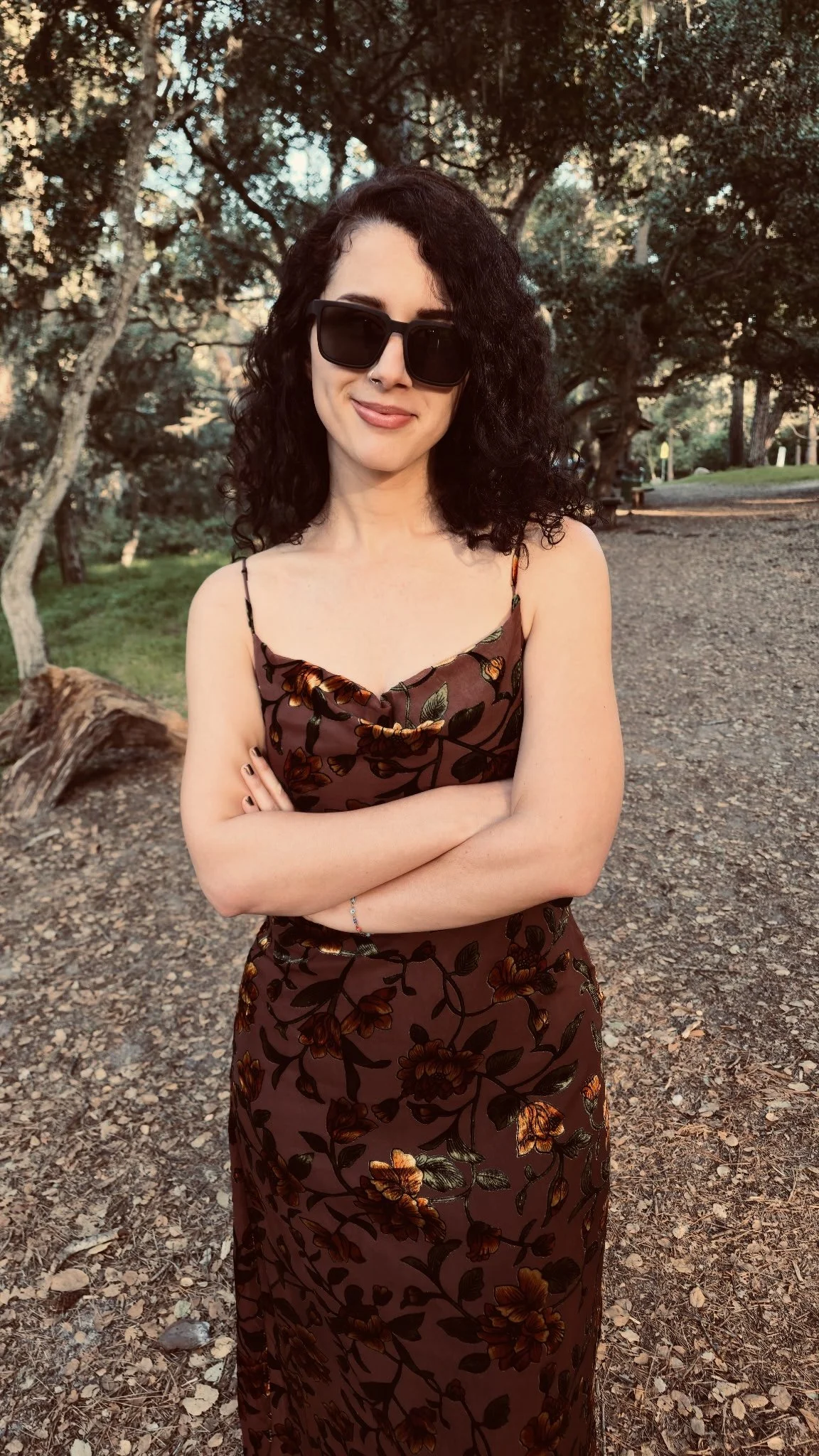
Dr. Ginearosa Carbone is an author, musician, and physician. Her writing includes horror and the illusion of normalcy, examining the thin line between safety and catastrophe. She was born and raised in California, where the earth is always threatening to open up.