Quiet Lovely
Betsy Bott
I’ve found valuable things on my walk to work—a fifty dollar bill and an abandoned hummingbird’s nest—as well as worthless but intriguingly odd things, like a baby doll’s smashed-in head, eyes uselessly blinking. Last week, I scored a metal bingo cage which still had most of its tiny colorful plastic balls, an enticing mix of letters and numbers. I’ve found personal mementos, torn-up love letters and some kid’s math test (B-), and handwritten recipes in loopy script on lined index cards. I once found a single high-heeled shoe, an unopened bag of gluten-free flour, and weirdly specific graffiti like: LARRY! I WANT MY MAKE-UP KIT BACK. I found a professionally printed sign stating, in solemn white letters: THE IMPORTANCE OF COMMUNITY. This had been placed carefully, incongruously, under a tree.
“So, it’s about finding a use for things. You hate waste,” summarizes Yuki. She’s blowing on her steaming cup of coffee, searching my face for confirmation.
“Right,” I agree, for some reason. It’s part of the truth, anyway. Yuki nods firmly, as if the point is now settled. Yuki likes to know what’s what. She claims to like my artwork, but I don’t know if she really does or if she’s just being supportive. As my best friend, she is required to like everything about me.
The bell over the door jingles as a couple walks in. Yuki takes their order; I pull shots of espresso and pour milk into a metal jug. I like the way the nozzle sputters and purrs, making hot, milky bubbles, reminding me my cat, Brambles. I found her, too. She was shivering and matted, hiding in a thicket. I had to coax her out.
“CYBORG!” Yuki yells suddenly, affectionately. The door slams back, bell swinging wildly, and Cy explodes into the café.
“LADIES, MORNING. Another day in paradise!” he booms.
This makes no sense, as it’s always raining in Seattle, but he has already made a beeline to his backroom office. Yuki and I ignore most of what he says, anyway. He’s not a bad boss. He likes to shout, but doesn’t really mean it. Once in a while, he half-heartedly fires one of us (usually Yuki), but never makes it stick. With his bald head and shiny gray suits, he’s like an ineffectual Lex Luthor.
I hate waste: it’s true. I recycle junk by turning it into art, but recycling is wholesome. My motivations, on the other hand, feel unwholesome—more like compulsion, or a kind of vigilance. I’m driven by a restless energy, searching for puzzle pieces, only the puzzle is three-dimensional, spanning time and distance. When I find something I can use—even if it’s just a bit of coiled wire or a scrap of paper—the tension in my throat eases, just for a minute.
My mom used to tell me she found me in the book return bin (she was a librarian); a newborn baby curled up on a pile of paperbacks. I got put in the slot and returned, I boasted to kids in my fourth grade class—but the kids told my teacher who told my mom who had to break it to me, shame-faced, that it was a joke. I was crushed; I loved my origin story. It was like being a character in a fairy tale.
“Psst, Petra,” says Yuki, in the world’s loudest stage-whisper. “There’s the guy. The one who’s been staring at you all week.”
We’ve finally finished serving everyone and Yuki is leaning on the counter, resting her face in her hands, long shiny hair flipped cutely to one side. She cartoonishly nods in his direction, in what I’m sure she believes is a subtle gesture.
I sneak a glance. He’s drinking a cappuccino, wearing a black cotton shirt, engrossed in a hardcover book. “I don’t think so, Yuki.”
Men don’t notice me. Yuki, on the other hand—men do watch her. She’s slender, with a lithe dancer’s body, sweet heart-shaped face. Except for my large nose, I look just like my mom: squished face, bushy brows, beady eyes.
“No, really,” insists Yuki. “He can’t take his eyes off you. I think he’s kind of hot.”
“Ew, no. He’s too old.”
“He’s a silver fox. He likes your work, too, I can tell.”
I doubt this. My artwork is currently displayed on the walls at Cyclops Café; I’m twenty-three years old and definitely not a name in the art world. I’m just someone who likes to make things. Yuki coerced Cy into displaying it; I’m not sure why he eventually caved. I assume it was out of kindness, or maybe he (mistakenly) thought it would make her work harder.
The man at the corner table is seated beneath my favorite and most personal piece. I named it Quiet Lovely after something from an H.G. Wells story that my mom used to talk about. I used streaks of yellow paint (my mom’s favorite color) and torn-up blue fabric from a dress she used to wear, layered with library check-out cards—the kind with dates stamped on them and signatures—and some old family photos my mom gave me. She said they were too unflattering to make it into the family albums, but to me, these photos are the most special because they capture the unguarded moments. They are the most real.
I took the time to painstakingly label each work, in an effort to appear professional. I ludicrously overpriced this one because I could never bear to part with it. The label reads:
Petra Nicewonder
Quiet Lovely, 45 x 65 in
Mixed media: Cardstock, fabric, photographs, acrylic on canvas
Price: $3,000
On my walk home that night, I encounter dark portents: a flattened rat on the sidewalk, a half-eaten sparrow in the grass. A maniac screams about the evils of abortion; I cross the street to avoid him. A poignant flyer pinned to a telephone pole pleads “HAVE YOU SEEN UMBERTO?” above a photo of a stern white cat.
Yuki pounces on me at work the next morning.
“Look at this pine cone I found,” I say, holding it up. It’s so large, the wood is thick, like something carved instead of grown.
“What’s wrong with you?” She regards the pine cone like it’s a turd. “Listen, I have unbelievable news.” She stretches out the syllables: un-buh-leev-able.
“Yuki, there’s a line of customers here.”
The four people in line stare daggers at Yuki and look approvingly at me as I take their orders, but the truth is, I don’t care about the customers either. I just find Morning Yuki to be a bit much. When we’re done with the customers, Yuki excitedly reaches under the counter and thrusts a stack of money at me. The bill on top is a hundred dollars. I flip through it—they’re all hundreds. I look up at her, uncomprehending.
“It’s three thousand dollars!” She’s vibrating with excitement.
A burst of panic. My mind makes the connection, and turning to the wall above the corner table, I see the blank space where Quiet Lovely used to be.
For a moment, everything is still. Then, I’m falling off a cliff and my lungs are shattering into a million pieces, or maybe it’s a tsunami rushing in, crashing over us, breaking me into thin shards of glass, cutting me open. Death by a million slivers.
“Petra,” Yuki grabs my arm, scared now. “Are you okay?”
I look into her stupid, worried face. I’m blank, expressionless. My voice, when I speak, is calm and even. I’ve left my body, floating, looking down at us from miles away.
“I will never forgive you,” I say.
********************
“Just keep an open mind,” Yuki says on the drive over.
“I’m serious, Yuki. I’m not selling.”
After a semi-big fight at the coffee shop that may or may not have ended shortly after Cy finally forced his way between us and banished us to the back office to shout at each other there instead of in front of the customers, I made Yuki call the buyer and get him to agree to return my artwork. He resisted at first, but, in the end, he was no match for Yuki, who tends to be very persuasive, especially when overwrought. He did, however, insist we do the exchange over dinner at his house on Mercer Island—our current destination.
“I just have one suggestion,” Yuki continues.
“No.”
“Come on! You haven’t even heard what it is.”
“The answer is no.”
“I’m just thinking maybe we can negotiate the price up.”
“I’m not selling.”
“Petra, this guy is loaded. I looked him up. His name is Matei Andrei. He’s a restauranteur.”
“Good for him.”
“And he’s classy. An expat. He’s from Romania. Like Dracula.”
“This just gets better and better. So we’re dining with Dracula now? Does he have fangs? Why is this not alarming to you?”
When we find the right street, Yuki tugs on the steering wheel, making a hard left into the driveway. “Oh, look, Dracula has a Free Little Library,” Yuki says dryly as we exit the car.
I admit the house looks innocuous, with overgrown pink rhododendrons taking up most of the front yard. It’s almost six o’clock, but still light out, a long summer day in June. The gravel crunches under our feet, and I fight back a flutter of self-consciousness in my scuffed sneakers, hoodie, and jeans. I didn’t even wash my hair. Yuki, on the other hand, is effortlessly sophisticated in a tiny dress, hair piled on top of her head and fastened with a big sparkly pin.
Before we can even finish knocking, the door swings open, and Matei and Yuki are greeting each other like old friends.
“Salut,” Matei says. “Welcome, friends! Come in, come in. And you are the artist, Petra?”
In lieu of a response, I shove the cash at him, which he takes, reluctantly. He tosses it immediately on a table in the entranceway, like it’s so distasteful that he can’t get rid of it fast enough, this stack of more money than I’ve ever seen in my life.
His home is inviting, airy, and light, with a view of Lake Washington, bossa nova playing softly in the background, and a deep, savory smell floating in from the kitchen. Despite this, all I want is my artwork, which I clock instantly hanging over the fireplace. It pulls me in like a magnet, drawing me close. Absorbed by my mother’s image, my favorite photo of her, I’m flooded with a sense of well-being. This image captures her as a young woman, in a rare, unguarded moment. She’s looking up, laughing, her eyes lit from within. It’s so odd to be looking at her face in this stranger’s house. In this room of expensive furniture, intricate lighting, and actual, professional art, my amateur attempt does not fit. It is incongruous.
“Why do you want it?” I hear myself blurt.
“It matches my living room,” Matei says, lightly. He has walked up behind me and is looking over my shoulder. “I’ve made a traditional Romanian soup, ciorbă de perișoare. Do you like soup?”
He offers us glasses of white wine. I take the wine but ignore his question. I resent the delicious smell of the soup, my traitorous stomach growling. “But it doesn’t match,” I say.
“What?”
“My painting. It doesn’t match at all. It’s yellow and blue. Your walls are mauve.”
Matei turns to answer, but Yuki interrupts with a question about art, and the conversation surges onto another topic. I don’t think Yuki really knows anything about art, but she’s bullshitting impressively. When Matei excuses himself to fetch a platter of hors d’oeuvres, Yuki smiles coyly at me over her glass of white wine. “He’s obsessed with you. If you don’t marry him, I will.”
“Yuki, get serious. Why does he want my artwork? Look at all this real art.”
“Your art is real art,” she says, defensively.
Matei returns with the hors d’oeuvres, artfully arranged on a silver tray. I snatch one, some kind of crab paste on a cracker. It melts on my tongue, delectably, and when he’s not looking, I grab a few more and cram them into my mouth. Matei discusses the many different kinds of Romanian soup while Yuki flirts.
“Oh, Soreena!”
A prepubescent girl of about twelve lopes vaguely into the room and hovers shyly near her dad.
“Hi! I’d like you to meet my daughter, Soreena. I hope you don’t mind if she joins us?”
He wraps his arm around her, giving her a little squeeze. She’s tall and striking, with blonde hair and a large nose, her skinny limbs protruding awkwardly from an oversized t-shirt and shorts. She looks limply in our direction, instantly bored.
“This is a classic Romanian soup…” Again with the soup, I think. “You can use whatever you have on hand: scraps of vegetables, herbs, anything you have lying around. I hate waste.”
I hate waste. I put my glass of wine on the bar. I feel funny. Hot. “You look familiar,” I tell Soreena. She shrugs, helps herself to the crab paste crackers. “Have we met? Why do you look familiar?”
“Petra, are you okay?” Yuki is looking at me, concerned. “Why don’t you sit down?”
“No, I don’t need to sit.” But I feel a strange rush in my head, like I might faint. The walls wobble and my throat tightens.
“Petra, you look a bit green.”
Then I see it. I don’t know how I missed it before. Soreena’s distinctive nose and the H.G. Wells book from the café. The photo of my mom, and Matei’s mannerisms, the way he looks at me. A hundred little clues falling into place.
Now I know, and looking at him, I can tell that he knows I know.
“I have to go,” I say, my voice strangled. I can barely get the words out.
“No, no, please don’t,” he starts in, his voice rising with desperation.
I stalk across the room to Quiet Lovely and rip it off the wall. “This is coming with me,” I announce.
“Please, just stay for dinner. We will discuss!”
“What is going on?” Yuki: utterly confused. Soreena is confused, but also riveted; her dark, intelligent eyes take everything in, blackness absorbing light. She has thick lashes like mine. I don’t want to feel anything for her, and I fight the surge of sympathy welling behind my eyes. “I’ll tell you one thing—you’ll never have Quiet Lovely!” I hear myself say, like it’s the goddamn Mona Lisa.
I’m about to unleash all kinds of batshit pronouncements—I can no longer stem the flood of words escaping my mouth—which means I need to get out of there as fast as possible. I can’t let myself lose control; it’s not fair to Soreena. All I know how to do in this moment is run—run out the door with my artwork like a crazy person. Matei and Yuki follow me, but I don’t stop running until I’m safely in the car, my artwork in the back seat, windows up, door locked. Matei pleads with me, saying something, but I can’t make out the words. I can’t leave without Yuki, so I plant my hands on the steering wheel and stare straight ahead.
Eventually, she slides in next to me. “I’m sorry, honey,” she says. “I’m so sorry. Don’t cry.”
“Give me the keys.”
I shove the keys into the ignition and floor it, wrenching the steering wheel hard, and we peel out of the driveway in a flurry of gravel and dust.
I want to tell her how it feels—to spend your life collecting scraps and clues, piecing them together, translating symbols and signs, only to solve a mystery that you didn’t even know you were working on. I’m bewildered to realize it now, too late, that I preferred the puzzle unsolved.
I want to tell her, but she already knows.
I’m driving too fast. Yuki’s car is her baby, but she’s letting it slide. In this moment, I think she would let me drive ninety-five miles an hour if I wanted to.
“We got the painting back,” she says after a beat. “So there’s that.”
We continue in silence for a while.
“What did he say?” I can’t help it, I have to know.
“You mean, after you got in the car?” Yuki pauses. “He said,‘You look like her. I loved her so much. I called her my Quiet Lovely.’ ”
The sun is setting and it’s starting to rain, the raindrops tapping lightly against the windshield. I switch on the wipers and they swish rhythmically, mixing with the sound of raindrops, as my heart rate slows. The sky darkens and streetlights begin blinking on. Neither of us says anything for a long time.
ABOUT THE AUTHOR
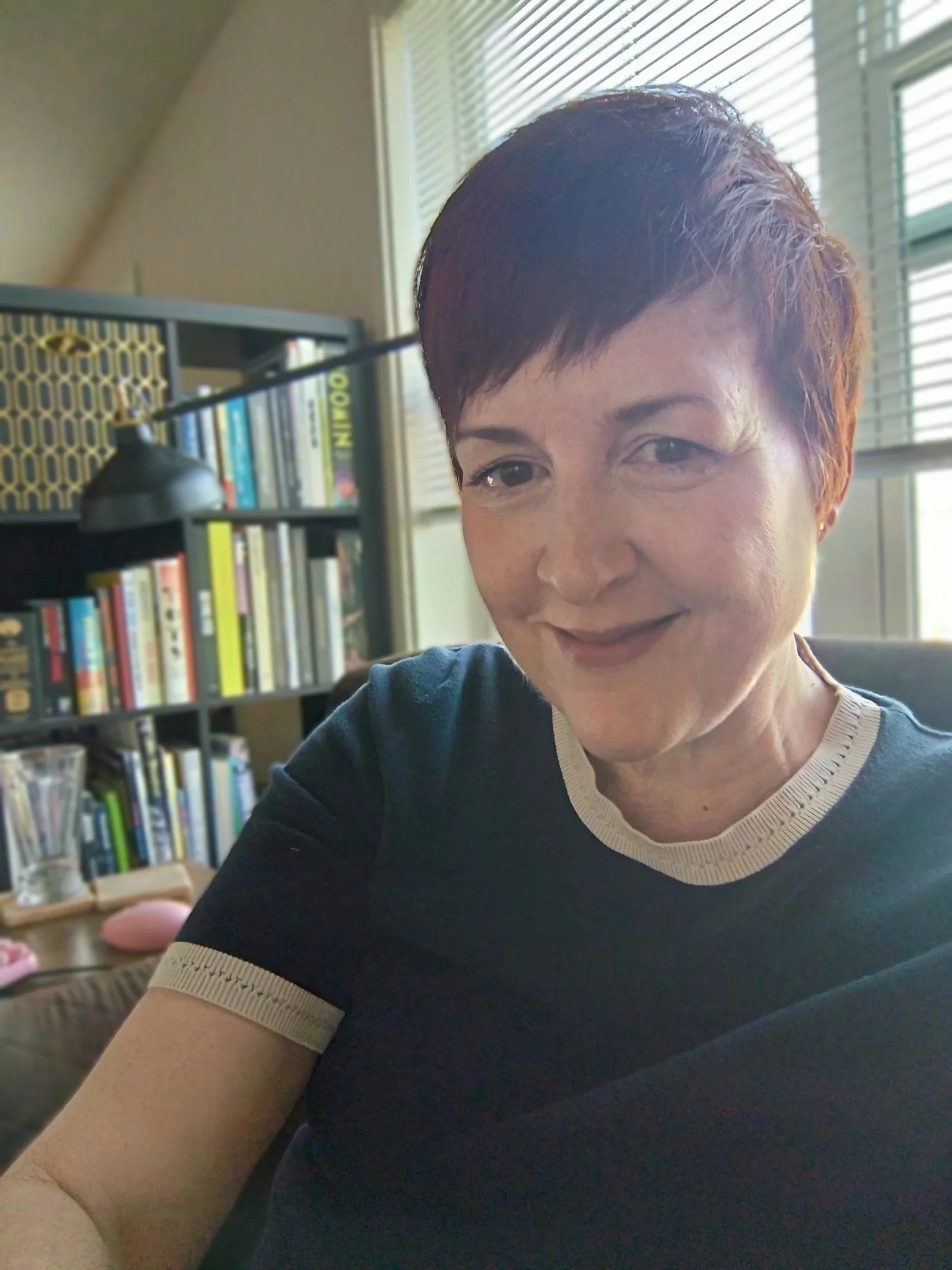
Betsy Bott was born and raised in the Bronx, and currently lives in Capitol Hill, Seattle with her husband Jason and an orange cat named Franklin. She studies writing at Hugo House in Seattle. Betsy loves animals, even the unpopular ones like pigeons, snakes, and rats. You can find her on Instagram — @beebo_mcweeb.