Indigo for Solas
Eileen Stelter
The shaman said the morning fog descending onto the lake was the ghosts of the dead slowly returning to their beds and handing the world over to the living. I disagreed. I thought it was nothing more than water suspended in the air, but that was probably why the spiritual leaders didn’t like me all that much.
Lazily chewing on a stick of willow tree hanging from my mouth, I got the boat in order and checked my tools: flints in all sizes and antlers for sharpening, all rolled up in a thin piece of deer hide. I tossed it into the boat. The next bag I heaved into it was a lot bigger—and heavier, too. I secured it at the back of the boat for stability, twisting my body as I fastened the leather strips around it, making sure they wouldn’t come undone with the first wave.
The willow bark hit that one sore spot in between my molars and I winced, letting go of the leather strips in favor of cupping my jaw. It had been fine before I had eaten that one piece of aurochs bone marrow. The one that had an entire splinter of bone in it. The same one that clumsy Solas had prepared for me. I knew I should have turned it down when she had offered. She was so unskilled in pretty much everything that mattered.
Speak of the devil: a creepy creature was lurking in the dark and I flinched once again, but not because of my teeth this time.
“Fuck’s sake, Solas,” I hissed, my hands falling to my sides before she could get a look at what I was putting in my boat. Scrawny Solas was not only downright eerie the way she was always loitering, but also nosy as hell. Most of the time I didn’t even know where she was coming from. Or where she had hailed from in the first place. She didn’t look like anyone from our tribe. My brother said that her mother had her with someone from a northern tribe, conceived during a sun ritual on the first day of winter. That’s exactly what she looked like with her icky white hair. She looked like a stick figure with a tuft of poplar fluff on top.
“Where are you off to?” She asked, eyes all round and inquisitive. They were freakishly large too, nearly jumping out of her face with how light they were. None of the deep-set browns all of us shared.
“Fishing,” I huffed. “Get lost, Solas.”
She didn’t. Solas never did. Instead, she stepped closer, bending down to investigate my bag. I shooed her away with my hand like I would a hyena pup but instead of leaving, she held a small pouch to my face.
“What’s that?” I sniffed at it. It smelled like birch tar.
“For your teeth. I know they hurt you,” she said.
I narrowed my eyes on her. I knew Solas often assisted her sister Tocrag in healing rituals and some even went to her for herbal medicine, but I personally would rather endure the pain of rotten teeth than accept any of her remedies. The bone marrow only proved to me that I should be very hesitant to put anything into my body that Solas prescribed.
“Why are you giving me that?” I asked.
“I’m looking for indigo,” she replied.
I shrugged. “Tough luck, we don’t have that here until the trader comes.” I continued preparing the boat undeterred.
“That’s why I need to get some woad until then.”
“What kind of made-up plant is that?”
Her forehead wrinkled. “It’s not made up. People just don’t use it because they don’t know how to.” She jutted out her chin in triumph. “But I do, you know. I found out.”
“Fantastic,” I huffed, untying the cord that was securing the boat, ready to leave the bay under the lilac light of dawn. Shipping off into the ghosts. It was what made me the great fisherman I was: leaving the bay earlier than everyone else. Because I didn’t believe in that ghost nonsense, I had no issue with being out on the water longer, going farther, raking in more and better quality fish.
Solas walked past me.
“Hold up, where do you think you’re going?” I did a double take.
“I’m coming with you,” she stated, as if it were a done deal.
I grabbed her shoulder when she lifted her thin leg to step into the boat. My boat. “Sorry, have you lost your mind or something? You’re not coming. I’ve literally never spoken to you outside of meals.”
She blinked her weird light eyes at me. “Nobody has. But we’re tribe, right? The shaman says we have to look out for each other.”
I gave her a little push, barely a flick of a finger and she doubled over. “My way of looking out for you is to keep my distance and not bringing a stick figure out into the wilderness with me.”
“I’m not going to break,” she insisted, glaring at me.
“What do you even want to come out with me for? That precious woad plant? Describe it to me, I’ll get it for you.”
She furrowed her brows. “You wouldn’t get it.”
I shrugged and pushed the boat into the water. “Alright then.”
“Wait,” she hissed and launched at me again. I grabbed her by her frail shoulders and she yelped, clawing at me like a wild animal. I threw her over my shoulder.
“Listen.” I carried her a few feet away from the bay. She pummeled my back, but I barely felt it. A mosquito bite was more painful than Solas attacking me.
“Ferra, don’t be an asshole. Let me down,” she shrieked.
“I will.” I set her down and she fell on her bony ass. Which, honestly, probably hurt a lot, given that there was nothing to feather her fall. She glared at me, her eyes piercing like icy blue fire through the dark.
I turned on my heel and got into my boat, pushing it off the shore. I felt bad for Solas. Everybody treated her badly. But she was annoying as hell, always had been. At the annual sun summit, I had made the acquaintance of some tribes that got rid of their outsiders by making them climb into a cave to retrieve something, knowing full well they were more likely to get mauled by a cave bear than complete the task.
We weren’t that cruel to Solas. We just wanted her to keep to herself and not interfere. If it weren’t for Tocrag, Solas would be around for community time a lot less. But with her being the sister of our shaman and of the same blood as the one chosen by the gods, we had no choice. If we wanted to keep Tocrag happy, we had to include her weird sister.
A splash in the water pulled me out of my own thoughts and I whipped around.
“Solas, what the fuck,” I exclaimed for the second time this early morning. Her little body was paddling toward the boat, desperately trying to keep her head above water. She looked like a dog. Throwing a look at the stars and our ancestors, I mumbled a quick prayer and reached into the black water. I got a hold of Solas’ fur collar and pulled her into the boat. Rounding her back like a newborn cave lion cub that had fallen into the stream, she sat up, barely managing to catch her breath.
“Are you taking me with you now? Now that you know I can survive even the waters?” she gasped, water falling from her blue lips. “Now that you know how powerful I really am?”
I stared at her. Deadpan. Then I thought about how she was always under her sister’s thumb, her younger sister no less. And before that under her mother’s. Solas had never been trusted to do anything on her own. No one ever expected her to succeed because she was so sickly and small. I took pity on her. It must feel terrible to have even just a smidge of power inside of you, but nobody recognizing it.
In a way, she was the polar opposite of me. I was tall, broad shouldered, everybody believed me when I said I had survived something or had brought some beast to their knees. I was a leader of men. Technically. I didn’t want to be. But nobody ever questioned that, nobody ever questioned my mental strength because of the way I looked.
But Solas—small, sickly Solas—could have the most powerful soul hidden away inside her body and nobody would ever acknowledge it.
The thing was, if I took her with me, I would have to play it really coy. She was not to throw even so much as a single one of her nosy looks into my bag.
“Fine,” I pressed. “But we’re not stopping for you to dry off.”
She wrung out her fuzzy, white hair. “That’s okay. I’m hot blooded.”
I huffed again. Solas was like one of those cautionary tales of a hunter thinking they’re invincible when later in the story, they get thrown to the side by a mammoth tusk and their entire spine cracks like a sardine.
“If something happens to you and Tocrag comes after me—,” I hissed.
“My sister is too busy receiving messages from the divine,” Solas cut in, looking to the side, her nose crinkling in anger.
I sighed. “What do you even need the indigo for?”
“Not me,” she said a little too quickly. “Tocrag needs it. The gods want her painted blue for one of the rituals.”
“As in, her entire body?” I asked and Solas shot me a blank look.
I lifted my hands. “Only asking.”
“Yes, her entire body,” Solas whispered after a while and I started rowing us out of the bay. To my surprise, Solas didn’t shiver. Not even as the breeze picked up. Maybe she wasn’t lying when she had said she was hot blooded, no matter how unbelievable it might seem.
“You’re not setting up to fish,” Solas observed after a while, nodding toward the wooden harpoon leaning on the side of the boat while I was still rowing further down the stream.
“We’re not there yet.”
Solas extended an arm, aiming at a few spots all around the boat. “There’s fish everywhere. You could easily stop here and fill up your bags.”
I huffed. She was getting on my nerves. “No one brings home more fish than I do. Yet here you are, questioning my methods.”
She squinted her eyes but didn’t say anything. I had to get rid of her somehow. And soon. Naak would be waiting for me at the next riverbend.
“Where are you going to collect the woad you’re looking for?” I asked.
“Are you trying to get rid of me?” Solas caught my bluff immediately and I shuddered. I didn’t know why. It was just Solas, the weird girl from the tribe. We were most definitely related somehow. Why did she freak me out so much?
I looked past her shoulder, making out a humanlike shape in the distance. Naak. Shit.
“Isn’t that woad right there?” I stopped the boat and pointed at the riverbank that was covered in pale flowering plants. Solas’ forehead wrinkled.
“How would you know what woad looks like?” she asked. “You’re not really known for your smarts, Ferra.”
My eyebrows shot up. Did Solas just call me stupid? “You mentioned white flowers. I think you should go and check it out,” I said, already rowing toward the riverbank, touching down with the boat.
She slowly leaned over the edge of the boat, sniffing. She was so animalistic. All her movements originated from her shoulders, she didn’t move like a human. Having her this close to me filled me with unease.
I slipped my arms under her back and thighs and heaved her out of the boat. She yelped. I ignored her, wedging the ore into the sand, pushing the boat off the riverbank.
“Ferra,” she growled after me. Again, like an animal. I rowed faster. It was kind of on her to have trusted me, honestly. There was a reason a man of my build had turned his back on hunting. I didn’t do well with others. Fishing was great for that because you could do it entirely by yourself. Especially the way I did it.
Now rid of Solas, I turned the boat around the river bend. Naak was already waving at me and I secured my vessel.
“Well, what have you got?” Naak asked, grabbing my arm and welcoming me on the sand.
“For you, only the best,” I replied, pulling the big deer skin bag out of the boat. I had spent days on end carving the figurines in wood.
“Any bone ones?” Naak asked, eyes glinting with hope. He always said he was looking for bone, but that was bullshit. What he was really looking for was ivory. He just didn’t know what the difference was, because he was shit at making anything himself. That was the foundation of our whole deal. Naak wasn’t good at making things, so he traded them. And I wasn’t good at anything other than carving, especially not fishing or any other skill that would feed the tribe, so I traded too. In secret.
I shook my head. “No, Naak. I told you there’s no way I can get a hold of this much ivory without the hunters noticing.” Bone was too brittle to carve like that. It had to be the real thing.
The glint of hope in Naak’s eyes was extinguished like a flame in the breeze.
I huffed, sliding the deer skin open. “But I have new silhouettes.” I pulled out one of the naked ladies.
Naak whistled through his teeth. “I like it.”
“I thought you would,” I murmured. I only carved what I thought other men might find attractive. This wasn’t for me, this was for other tribes. They may have other preferences. I sometimes got to talk to the men at the sun festival to do a bit of market research. No matter what tribe they were from, every single one of them enjoyed breasts in some way, shape or form.
So I carved them in all different sizes on little wooden statues. I took out more and more and lined them all up beside each other so Naak could make his pick.
“This one’s weird. But I’ll take it, maybe someone is into that.” It was a thin sculpture, almost like a stick figure. I made it when I had run out of material. It actually resembled Solas a lot, now that I thought about it.
“Before you take it,” I softly took the figurine he was holding out of his hands. “What do you have in exchange for it?”
Naak smiled. “I got some blubber this time. From up north. It’s fermented. The really good stuff.”
I sighed. “Naak, I can’t take that. I can only take fresh fish, you know that.”
The trader clicked his tongue. “Right. Your big cover-up.” He pinched my bicep. “Keep the blubber for yourself. One piece will get you through the entire winter and make you grow a few more muscles, huh?”
“Fresh fish, Naak. I don’t want to be caught,” I insisted.
“What’s this?” a thin voice sounded beside me.
I jumped. Solas had appeared right under my arm out of nowhere. I seriously didn’t know how she did it but she was just as nimble as she was scrawny, it seemed. Her white hair clung to her face, droplets falling onto her skin, but she didn’t seem to care. She must have paddled her way here like she had before.
“I asked ‘what is it’,” she repeated and snatched the figurine from Naak’s grasp, turning it over in her hand. Glaring back at her were a pair of very prominent tits.
“That’s Tocrag,” she said.
“No,” I retorted.
“It is. I know what she looks like.”
“Who’s Tocrag?” Naak asked.
“Our shaman,” I said, reaching for the figurine in Solas’ hands but she turned, moving it out of reach.
Naak let out an approving whistle. “A naked shaman will sell for a good chunk of ivory, I imagine.”
“It’s not Tocrag and you’re all up in my business,” I said, snatching the figurine of the naked woman from her grasp. I ran a finger over the wood lovingly. This particular one took me a good while to carve.
“You’re not a fisherman,” Solas concluded. “You make dirty figurines of women against their will and trade them.” Her gaze wandered over Naak’s leather bags. She crinkled her nose and sniffed. “You trade it for fish. The fish you tell everyone you caught yourself.”
“He carves men, too,” Naak cut in. “For the record. They all kind of look like himself.”
I shot him a dirty look. Way to rat me out, Naak.
“Now isn’t that a secret,” Solas murmured, a smirk tugging at her lips.
“I do not carve real women from our tribe, Solas. They’re all imaginary,” I said.
Solas giggled. “You will treat me so well from now on. Oh Ferra, you will protect me from everything I need you to.” She grabbed another figure from the line up in front of Naak, tested the weight of it, threw it into the air and caught it again. “I wonder what Tocrag will think of this.”
“Please don’t show this to Tocrag,” I blurted out and Solas’ grin spread even wider. I cleared my throat. “I mean, whatever. Show it to her, see if she’ll believe you.”
But Solas was smart. She saw right through me. “If you don’t want me to show this to Tocrag, you need to do something for me, that’s the deal.”
“I don’t remember agreeing to a deal with you.” I pressed a fist into my hip.
“I want you to protect me from our tribe.”
“Protect you from our tribe?” I wrinkled my forehead in confusion. “From what exactly? Bullying?”
Her eyes changed, turning a little darker somehow, the blue in it getting swallowed up by the black center. “Yeah, the bullying. We’ll shake on it.”
I rolled my eyes and grabbed her frail hand. It was like having a bird in my palm.
“I won’t rat you out and you will protect me. This is coming together nicely,” she crooned, looking like a vulture. She was such a creature. I reminded myself that she was way too small to ever be a threat to me. Solas didn’t have it in her to harm anything. She couldn’t even properly separate marrow from the bone.
Naak grimaced, throwing the thin wooden figure that resembled Solas back at me. “Keep that one.” I caught it and slipped it in my pocket.
Solas, Naak and I all loaded the fish into my boat. I also took the fermented blubber, but kept it separate. When everything was tight and secure, me and Solas rowed out of the bay once more.
“You know, you putting pressure on me to do something for you doesn't sit right with me,” I said.
Solas looked out at the river, not even fazed by my words.
“Stop here,” Solas said, her hand touching my arm. “There’s woad right there.” She pointed at white flowering plants softly moving in the breeze. I blinked. I wasn’t aware that it was known as ‘woad’. I had seen it plenty of times before. I always thought it had a different name, but then again, I never listened much when anyone tried to explain plants to me.
Solas got out of the boat and rummaged for something in her satchel, finally pulling out a thin deer hide, carefully covering her hands with it.
I watched her intently.
“It’s important you cover your hands because otherwise the pigment will stain,” she explained, picking two stems with pointy fingers. I didn’t see it leaving any stain on the leather.
She paused, pressing her lips together, her gaze flicking between the plants in her hand and the ones still in the ground. She plucked a third one.
My forehead wrinkled. “Will that be enough?”
“More than enough.”
“For her entire body?” I asked again and Solas gingerly draped the deer skin over the flowers.
“Get your mind out of the gutter,” she scolded me but her voice was shaky.
I drew in a sharp breath. I didn’t even have to imagine anything graphic to know that Tocrag was not going to even have her left elbow painted blue from the pigment found in three sprigs of woad.
Solas rolled the deer hide up in another deer hide and I narrowed my eyes on her. I understood that blue was a precious pigment, but only if you traded it from faraway lands. This was pretty much homegrown and the whole place was covered in it. It didn’t make any sense.
“What are you staring at me for, Ferra?” Solas hissed, jutting out her pointy chin. “Are you trying to figure out how to carve me properly so you can sell me to that smuggler Naak?”
“Don’t flatter yourself. You wouldn’t sell for much,” I replied and reluctantly pushed off the sand. With Solas this time. I wouldn’t leave her behind like that, even though I was tempted.
The entire journey back to where our tribe had set up camp, she was clutching the woad to her chest. It was weird. I had never seen anyone be so attached to any type of plant, especially not one that was so abundant.
After I secured the boat, I wanted to take the bag from her but she swatted my hand away. I froze, watching her as she climbed out and beelined straight to her tent.
I ran after her.
“Ferra, what are you doing?” Solas hissed.
I caught up to her. “You want my protection, don’t you?”
“But not like that, everybody’s staring. People might think we’re—” She paused, gesturing between us. “A thing.”
My brows shot up. Solas was concerned people could think we were together because she was embarrassed about it? The sting in my chest was palpable. I was way more attractive than she was. If anything, I should be concerned about being seen with her, not the other way around.
Her tent flap hit me in the face, but I pushed it back up, stepping in behind her.
“What are you doing with that?” I asked straight up, cornering her. I was towering over her. Next to me, Solas looked even more like a child.
“That’s none of your business,” she hissed, clutching the plant to her chest.
Her tent was small and cramped. All kinds of dried plants hanging from the wooden poles, hitting me in the head. In one of the corners I saw a big clay pot with blue fingerprints on it. Filled to the brim with indigo, I bet.
“That plant you have there isn’t woad is it?” I asked, taking another step toward her.
Her back hit the wall of the tent. “Yes, it is. I’m out of blue pigment, I told you.”
I didn’t answer. I walked over to the clay pot and lifted the lid, uncovering an unearthly amount of blue pigment. “What’s this then?”
Solas’ eyes flicked between me and the indigo, clearly caught red handed—or blue handed if you will, and her shoulders sank. This was too easy. Solas was no professional grifter like me.
“It’s to prank Tocrag,” she whispered, avoiding my gaze.
“Prank her?” I looked at her, puzzled.
“All the impressive things she’s doing? All those precious visions from the ancestors?” she spat, decades of resentment bubbling to the surface. “She’s parading around the campgrounds like she’s more god than human.”
I stared at her. “So, you want to knock her down a peg,” I concluded.
She sighed, kneading her palms. “The plant isn’t woad. It’s to make her have visions that don’t come from the gods, that won’t prove to be true. To make her look stupid in front of the whole tribe.”
I chuckled. Maybe Solas and I were more alike than I thought, after all she did have a little bit of grifter in her. If the whole tribe stopped believing everything was a godsend and the morning fog were the ancestors lingering from the night before, maybe more of us would dare to row out early. Or at night even. What monuments would be possible if we took a step back from that false spirituality that was holding all of us back? The mammoth bone structures during the sun rituals would only be the beginning. What if we would be able to carve stone one day?
I clicked my tongue. “Knock yourself out.”
“What?” Solas narrowed her eyes at me. “You’re okay with it?”
“Listen, I have no issue with Tocrag being humbled a little. The opinion of the shaman weighs a bit too heavy these days.”
Solas smirked. “So we’re partners then.”
I leaned in closer. “I wouldn’t go that far, Solas. You won’t rat me out and I won’t rat you out. And that’s about it.”
I turned on my heel and left Solas’ tent. After all, I had fresh fish to deliver.
********************
“Ferra, I need your help.” A voice as delicate as the first flakes of snow being carried down from the mountains sounded through the camp.
Tocrag rarely called on me. But anytime she did, she needed muscle to do whatever she wasn’t able to herself. I pulled the willow bark from between my teeth and winced at the loss. Technically I could have used Solas’ birch tar concoction. But I would rather be toothless and have all my food pre-chewed for me than take that chance.
I slipped into Tocrag’s ritual tent.
Unlike her sister, Tocrag was beautiful. Hauntingly so. I believe that was why everybody thought the gods had chosen her as their vessel. If I were a god, I would choose Tocrag as my vessel any day. That sounded wrong.
Not that Tocrag ever so much as looked at me when she didn’t need me to do something for her. That didn’t stop me from being at her beck and call. She was that beautiful.
“Thank you, Ferra,” she said, as I carried heavy logs of wood inside.
I did a double take. Tocrag never thanked anyone. Ever. Especially not me.
“Anytime,” I choked out, setting the logs down. Maybe she had noticed how my muscles flexed, how broad my shoulders were. Maybe she was going to choose me for a fertility ritual soon? A blush crept up into my cheeks.
Tocrag drew circles on the ground with white chalk. “The sky will cast over soon. The ancestors are about to descend for the night,” she murmured, not looking at me.
“How do you know all this?” I asked and she turned, long dark hair framing her delicate features. She smiled and I melted at the sight.
“The gods tell me, Ferra. They whisper it to me at night.”
“Every night?”
She nodded.
Following Tocrag’s prediction, the sky did cast over and our shaman called us in for the ceremony. To keep the malevolent ancestors away a fire was lit in the center of the tent and all of us were huddled around it. My eyes caught Solas, who was blankly staring ahead. I remembered that she wanted to play her prank on Tocrag and make her embarrass herself in front of everyone. The fact that Tocrag had thanked me changed my opinion on that. If I were to be in a fertility ritual with her soon, maybe it was time to bend my principles a little bit.
Tocrag, painted blue from head to toe, dipped an ivory bowl into the herbal tea brewing in a deer skin over the fire. She walked past each of us slowly, smearing one stripe of blue pigment on every person’s forehead. Her hand lingered a little too long on mine, I noticed. I smiled up at her and she returned it. My breath hitched in my throat. Oh, the gods were gracious tonight. If they existed, that is.
When she came to Solas, she lovingly grabbed her chin and placed a kiss on her lips, before dusting her in the pigment, the dark blue shining bright against her pale hair and skin. Solas grinned, her eyes fixed on the tea bubbling over the fire.
My stomach dropped. The tea was no doubt what Solas had tinkered with. I looked between her and the ivory bowl in Tocrag’s hands, frantically trying to come up with a plan that didn’t involve tackling her to the ground.
Tocrag knelt in the center of the circle, right by the fire, lifted the ivory bowl and brought it to her lips.
“Ancestors in the darkened sky, descend upon us,” she whispered and I panicked, calling out her name.
Tocrag stilled, her head whipping around to me. No one was to call upon the shaman during a ritual. But I had no choice. I launched forward, grabbing the bowl out of her hands, Solas’ stare burning a hole into the back of my head.
“Don’t drink that,” I whispered and Tocrag pulled the bowl back to her, spilling the hot tea over her hands. She flinched, the bowl landing on the ground, emptying its contents on the ground.
Solas launched forward, picking up the bowl. “Ferra, you’re ruining it,” she shrieked.
“You’re disrespecting the ancestors,” Tocrag hissed and a crack of thunder rolled through the campgrounds. Unrest spread through the tent, the members of the tribe shifting their weight, putting their heads together and whispering at the scene unfolding in front of their eyes.
Tocrag gestured for two of the hunters and they grabbed me and Solas, dragging us out of the tent. The way Tocrag looked at me, like she would never talk to me again and I had disrespected her beyond belief, was branded into my memory. Any chance I had with her was gone before it had even blossomed. The hunters pushed us past the tent flap and Solas stumbled, cutting her hands on the gritty ground. She hissed like a hyena cub.
“I couldn’t let you do that to her,” I murmured.
Solas shook her head, pushing herself back up and wiping her palms on her tunic. Wordlessly, she stepped past me, trying to sneak a glance through the gap in between the tent flap and the rest of the tent wall. Her face split open with a smug grin. “She’s continuing the ritual.”
I pushed Solas to the side, pressing my eyes to the leather so I could see better.
Tocrag was back on her knees in the center, the ivory bowl at her lips. She drank the tea, the liquid sputtering from her lips, but she kept going. It was of the utmost importance to finish the tea in one go, no matter how bitter it was.
Tocrag was ethereally beautiful even when she was choking down disgusting tea.
After the last sip, she tossed the ivory bowl into the fire and I had to resist the urge to launch at it again. What an awful waste of perfectly good material. There were so many figurines I would be able to carve for Naak out of that one bowl.
Tocrag rocked back and forth, her hips drawing wider circles with every new round.
More thunder erupted from afar and water came falling from the skies, its pitter patter sounding through the tent and soaking me and Solas outside of it.
My eyes found Solas. She looked tense, staring at me, waiting for my reaction, every single muscle in her body taut like a bow string. My forehead wrinkled.
Tocrag started twitching. Barely noticeable at first, but then she fell to the ground, cramping, shaking. One of the tribe leaders got up and frantically tried to get the pigment off her to see the color of her face but because she was covered in it, there was no way of telling.
All eyes were on Tocrag. Except mine. Mine were on Solas.
As the sounds of the commotion inside reached the outside of the tent, a small smile spread across Solas’ lips.
“What did you do?” I mouthed and her smile deepened.
I pushed the tent flap to the side ever so slightly, white knuckling the leather as my gaze fell onto Tocrag’s lifeless form. I should be bent over her like everybody else, but I knew Solas would slip away if I let her, so I grabbed her, hands locking around her frail arms like a vice.
“What did you do?” I asked again through gritted teeth.
Solas shied away for a moment, but rolled her shoulders back and stood a little straighter.
“Tocrag isn’t our shaman.”
“What do you mean?” I looked at her, puzzled.
“All the impressive things she’s doing? All those visions from the ancestors? That’s me, not her,” she hissed.
I stared at her. “You think you were chosen by the gods instead,” I concluded.
“I wasn’t chosen by the gods, Ferra. I am one of them,” she spat and I winced in surprise.
Solas let out a bitter laugh. “Anyone can whisper messages of the divine and pretend they’re a god if they observe nature well enough.”
She struggled against my grip, but being the stick figure that she was, she might as well have been a fly stuck to the inside of a tent.
“I made my visions mine, Ferra,” she whispered. “She’s never stealing them again.”
I stared at her, looking for some kind of indication in her face that this had been an accident. I didn’t find any.
“How did you do it?”
Her jaw was working.
I tightened my grip on her. “Solas, you wouldn’t do that, right? This was an accident?”
She pursed her lips, squinting her eyes in pure hatred. “It’s not woad, it’s hemlock. She deserved it.”
I shook her again, trying to force her to return to her senses. To my horror, her senses had never left her. She knew exactly what she was doing.
With woad or hemlock, I didn’t know.
The tribe leader walked out. I pulled Solas to the side, not wanting to be seen with her. She snickered.
“You’re with me on this now,” she whispered as we hid from the leader.
“No, I’m not,” I hissed back, watching him look for us.
“You and I both tussled over the ivory bowl. If they find us together, you won’t be trusted either. And if I tell my little story about how you sold naked figurines of Tocrag to other tribes, they won’t take you back.”
My stomach sank.
I looked to the sky, still cast over, fog descending over the bay. No ghosts, ghosts were a hoax. I wondered if Tocrag would come back as a ghost, all painted blue to haunt me and her sister. The same sister that I dragged with me into the fog as a wailing cry sounded from the ritual tent. One by one they all seemed to grasp that Tocrag was gone.
I pushed my boat into the water. Nobody dared to row out at night. Nobody dared to row out as far as I would be taking Solas now. But most importantly, nobody would dare to row out with a murderer.
But I didn’t believe in that kind of nonsense. Maybe that was why the shamans never liked me.
Because unlike Solas, they weren’t gods.
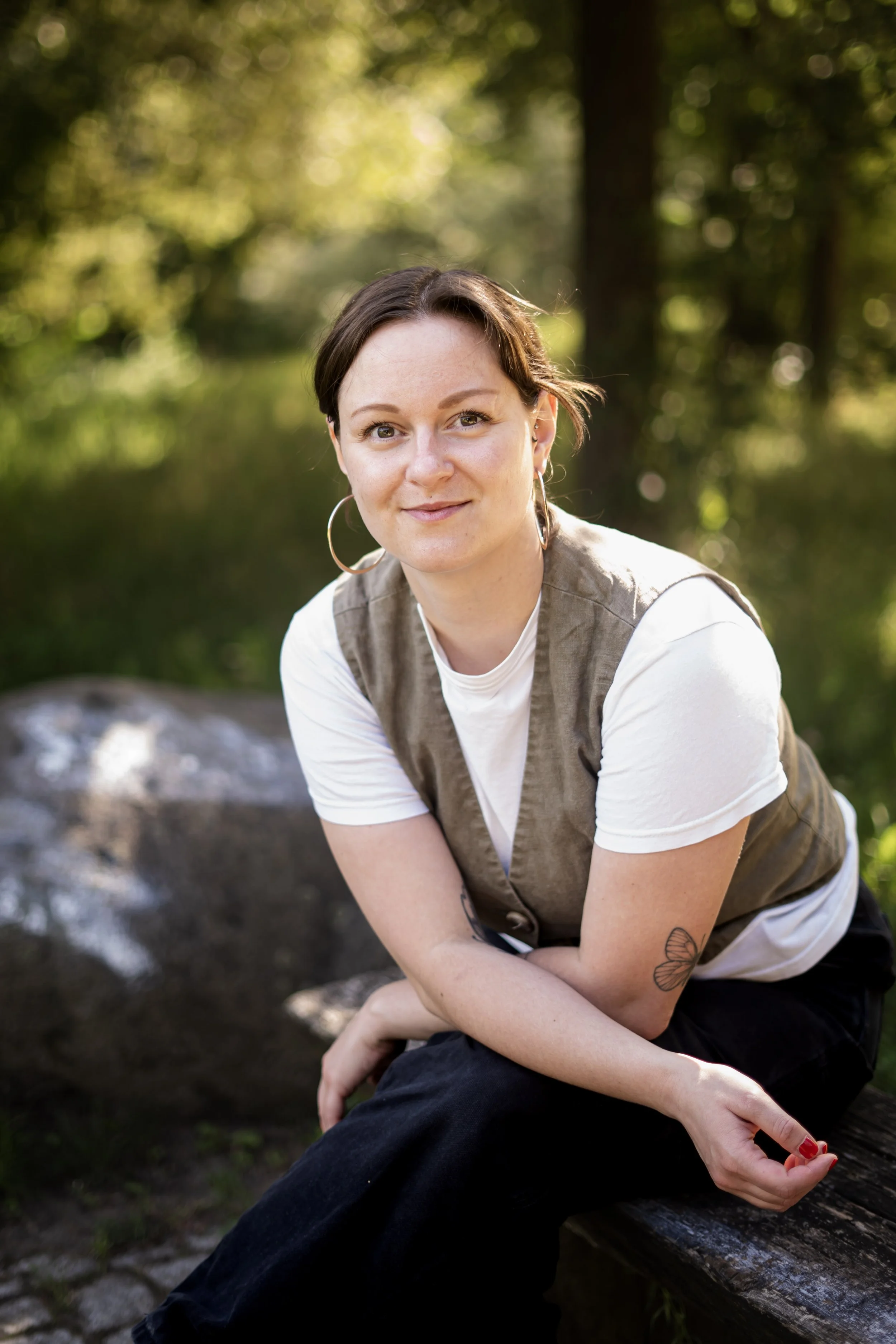
About the Author
Eileen Stelter (she/they) is a non-binary writer of fantasy and science fiction. They made their creative debut with a heartfelt apology to spiders and have since stayed loyal to writing love letters to working-class heroes and those who perform invisible labor. Their speculative fiction and poetry was published in various independent publications, including Feign, Moss Puppy, and Amsterdam Quarterly. They have won bursaries and awards from the Irish Writers Centre and have been shortlisted for MONO poetry prize 2023. Eileen lives with their three guinea pigs in Berlin and can be found foraging for wild herbs, fermenting, or updating their Tumblr.